For a growing number of American investors, the question isn’t just “how much can this investment earn me?” — it’s also “what is this investment actually funding?” That shift in thinking sits at the heart of ESG investing, a category that’s grown from a niche corner of Wall Street into a multi-trillion-dollar segment of the U.S. financial system, even as it’s simultaneously become one of the more politically debated topics in American finance.
Whether you’ve heard the term “ESG” thrown around in the news, seen “sustainable” or “green” labels on investment funds, or you’re simply curious about aligning your portfolio with your values, this guide breaks down what ESG and green finance actually mean, how big the space has become in 2026, the real debates surrounding it, and how a beginner can approach it thoughtfully.
What ESG Investing Actually Means
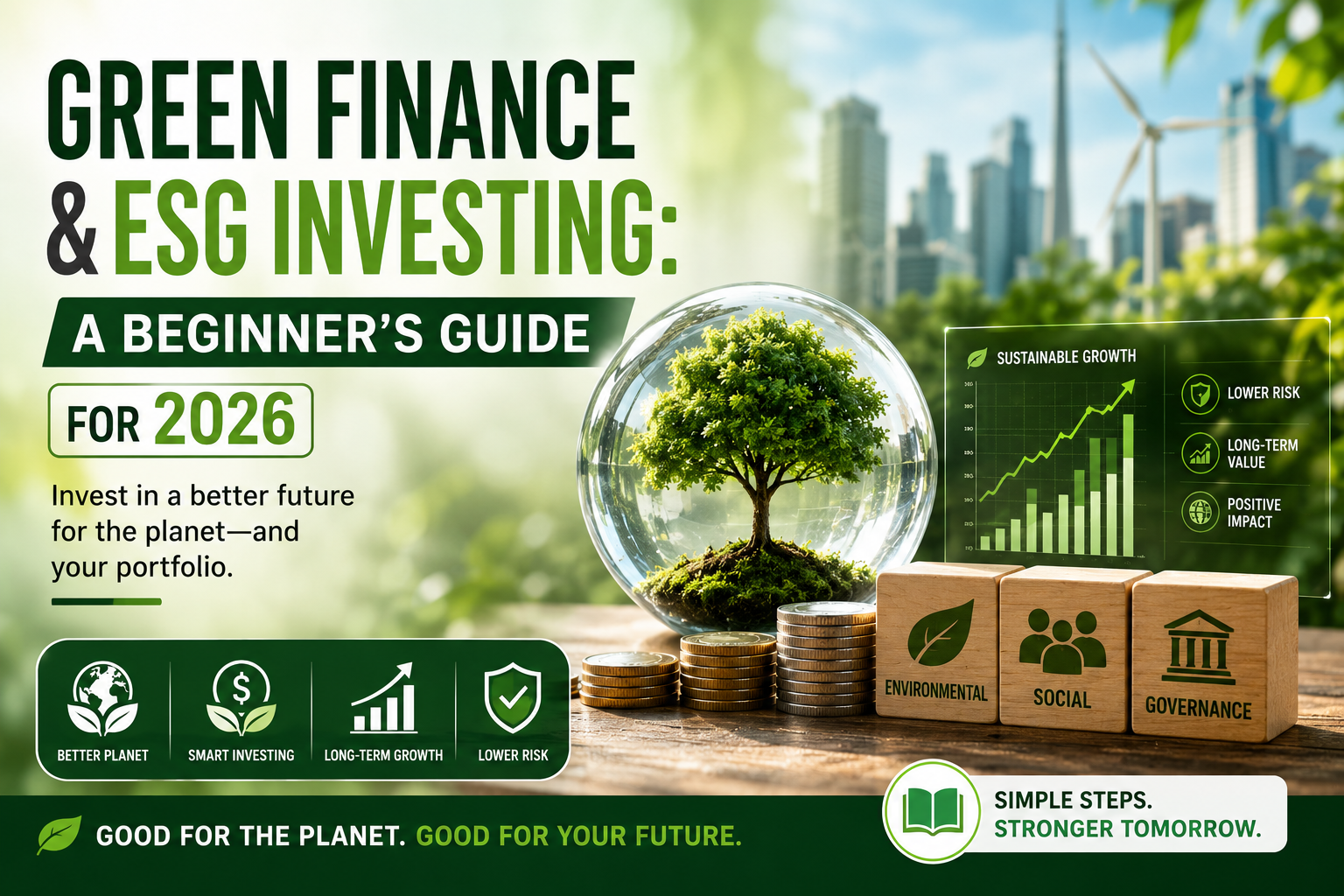
ESG stands for Environmental, Social, and Governance — three categories of non-financial factors that investors increasingly weigh alongside traditional financial metrics when deciding where to put their money.
Environmental factors look at how a company impacts the natural world: its carbon emissions, use of renewable energy, waste management practices, and overall environmental footprint. Social factors examine how a company treats people, covering areas like labor practices, human rights, data privacy, and diversity within its workforce. Governance factors focus on how a company is actually run, including board structure, executive accountability, and transparency in corporate decision-making.
Green finance is often used somewhat interchangeably with ESG, though it technically refers more specifically to financial products and investments tied directly to environmental and climate-related outcomes, such as green bonds that fund renewable energy projects or clean water infrastructure.
The underlying idea behind both terms is the same: investors can potentially generate financial returns while also directing capital toward companies and projects that meet higher standards on issues they care about.
How Big Is ESG Investing in America Right Now?
Despite significant political controversy in recent years, the numbers show that sustainable investing remains a substantial and resilient part of the U.S. financial system. According to the US SIF Foundation’s Sustainable Investing Trends Report, U.S. sustainable investing assets under management total approximately $6.6 trillion as of the 2025/2026 reporting period, out of $61.7 trillion in total U.S. assets under professional management.
Market projections suggest continued significant growth ahead. Some industry analyses project the U.S. ESG investing market could grow from roughly $9.19 trillion in 2025 to as much as $50.72 trillion by 2035, reflecting a projected compound annual growth rate of nearly 19% over that period, though such long-range projections should be treated as directional estimates rather than guarantees.
Perhaps most notably, industry sentiment has remained resilient despite political headwinds. Nearly 70% of investment professionals surveyed in the most recent US SIF trends report say they remain committed to sustainability’s long-term importance in investing, even as terminology and public messaging around ESG have shifted in response to political pressure.
The Political Controversy: Why “ESG” Has Become a Loaded Term
It’s impossible to give a complete picture of ESG investing in 2026 without addressing the significant political debate surrounding it — a debate that’s meaningfully shaped how the term is used and discussed.
ESG investing has become a genuine political flashpoint in the United States, particularly among conservative lawmakers who argue that incorporating ESG factors prioritizes social and political agendas over investors’ financial returns and fiduciary interests. Several states have taken concrete action in response. Texas, for example, moved to terminate a multi-billion-dollar investment relationship with a major asset manager over concerns about its ESG practices, and other states have taken similar steps to limit or restrict ESG-related investment approaches in public pension funds.
This political pressure has led to a notable shift in how the industry talks about sustainable investing, even where underlying practices haven’t changed dramatically. Rather than abandoning sustainability considerations altogether, many investment firms have recalibrated their language, increasingly emphasizing traditional fiduciary duty and financial materiality rather than leading with the term “ESG” itself. Industry analysts describe this shift as “recalibration rather than retreat” — sustainability-related investing continues, but the branding and public framing around it has become considerably more cautious.
At the same time, sustainability-related regulation hasn’t disappeared — it’s shifted toward the state level in several cases, with states like California and New York implementing their own climate-related disclosure and emissions reporting requirements for large companies, even as federal-level ESG-specific initiatives have faced more resistance.
The Case for ESG and Green Investing
Beyond the political debate, there are practical reasons beginner investors consider incorporating ESG factors into their investment approach.
Values alignment. For many investors, the primary motivation is straightforward: wanting their money to support companies whose environmental and social practices align with their personal values, rather than potentially funding practices they find objectionable.
Risk management. Proponents argue that ESG factors can serve as useful indicators of long-term business risk. A striking 84% of S&P 500 companies now identify climate change as a financial risk to their business, up significantly from 67% just a few years earlier, suggesting that environmental factors are increasingly viewed by corporate leadership themselves as materially relevant to financial performance, not just an ethical consideration layered on top of it.
Growing market accessibility. Sustainable investing has become significantly more accessible to everyday investors in 2026 than it was even a few years ago. ESG-focused ETFs, mutual funds, and green bonds are now widely available through mainstream brokerage platforms, retirement accounts, and employer-sponsored 401(k) plans, often with low investment minimums that make the category approachable for beginners.
Green bonds offer targeted impact. For investors who want their fixed-income allocation to fund specific environmental outcomes, green bonds and sustainability-linked bonds provide a way to directly finance projects like renewable energy infrastructure or water conservation efforts, while still functioning as a conventional bond investment within a diversified portfolio.
The Legitimate Concerns and Risks
A responsible beginner’s guide to ESG investing also needs to address the real, well-documented concerns that have emerged around this investment category.
Greenwashing Remains a Serious Problem
One of the most persistent criticisms of ESG investing is “greenwashing” — when companies or funds market themselves as environmentally or socially responsible without substantively backing up those claims. According to recent industry data, 85% of investors say greenwashing claims have become a more serious concern than they were five years ago, reflecting growing skepticism about whether ESG labels always reflect genuine practices.
The lack of a single, standardized rating system for ESG makes this problem harder to solve. Different rating agencies and fund providers can use meaningfully different methodologies to determine what qualifies as “sustainable” or “ESG-compliant,” which means two funds both marketed as ESG-focused might hold very different types of companies.
Performance Uncertainty
Despite years of academic and industry research, there still isn’t a definitive consensus on whether ESG-focused investments reliably outperform, underperform, or roughly match traditional investments over the long term. Many ESG-integrated funds in 2026 track broad market benchmarks fairly closely, suggesting that for a diversified ESG fund, performance may end up being similar to a comparable non-ESG fund — but this varies significantly depending on the specific fund’s strategy, sector concentration, and time horizon.
Regulatory Requirements Are Tightening, But Unevenly
The SEC’s “Names Rule,” which requires that at least 80% of a fund’s assets align with what its name suggests — meaning a “clean energy fund” must actually be substantially invested in clean energy companies — took effect with delayed enforcement, requiring larger fund groups to comply by mid-2026 and smaller fund groups by the end of 2026. This is a meaningful step toward reducing the risk of funds using sustainability-related names without matching underlying holdings, though enforcement and standardization across the broader ESG data landscape remains a work in progress.
Data Quality and Consistency Gaps
Nearly half of institutional investors cite ESG data coverage gaps as their biggest ongoing challenge, and a similar share report data quality issues or inconsistencies across different ESG rating providers. For everyday individual investors, this means it can genuinely be difficult to verify ESG claims independently, making due diligence on fund holdings and methodology more important than simply trusting a fund’s marketing label.
How Beginners Should Approach ESG Investing
For someone new to this space, a few practical principles can help navigate it thoughtfully.
Look past the label to the actual holdings. Before investing in any fund marketed as ESG, sustainable, or green, review its actual underlying holdings and stated methodology, rather than assuming the name alone guarantees a particular type of investment approach.
Understand that ESG isn’t a single, uniform strategy. ESG investing spans a wide range of approaches, from broad ESG integration across a diversified fund to narrow, thematic funds focused on specific sectors like clean energy. Thematic sector funds often carry higher volatility and concentration risk than broadly diversified ESG funds, so it’s worth understanding which type of exposure you’re actually getting.
Don’t sacrifice diversification for a values-based label. Sound investment principles — diversification, appropriate risk tolerance for your timeline, and low costs — still apply to ESG investing just as they do to any other investment approach. A values-aligned investment that isn’t properly diversified still carries the same fundamental risks as any other poorly diversified portfolio.
Check for green bonds and ESG options within retirement accounts. Many employer-sponsored 401(k) plans and IRAs now include sustainable investment options, offering a straightforward way for beginners to incorporate ESG considerations into their largest long-term investment pool without needing to open a separate account.
Stay aware of the evolving regulatory and political landscape. Because ESG investing sits at the intersection of finance and politics in the U.S. right now, product offerings, terminology, and regulatory requirements are likely to continue evolving. Staying informed, rather than assuming today’s landscape will remain static, is a reasonable expectation for anyone investing in this space over the long term.
The Bottom Line
ESG and green investing in the U.S. occupies a genuinely complex position in 2026 — simultaneously a multi-trillion-dollar, growing segment of the financial system, and a politically contested category facing real scrutiny over greenwashing, inconsistent data, and unclear performance outcomes. Both things are true at once, and a thoughtful beginner investor should approach the space with that full picture in mind, rather than either uncritical enthusiasm or blanket dismissal.
For those genuinely interested in aligning investments with environmental or social values, the tools to do so responsibly are more accessible than ever — but they require the same diligence, skepticism toward marketing claims, and commitment to diversification that sound investing has always demanded, regardless of what label is on the fund.