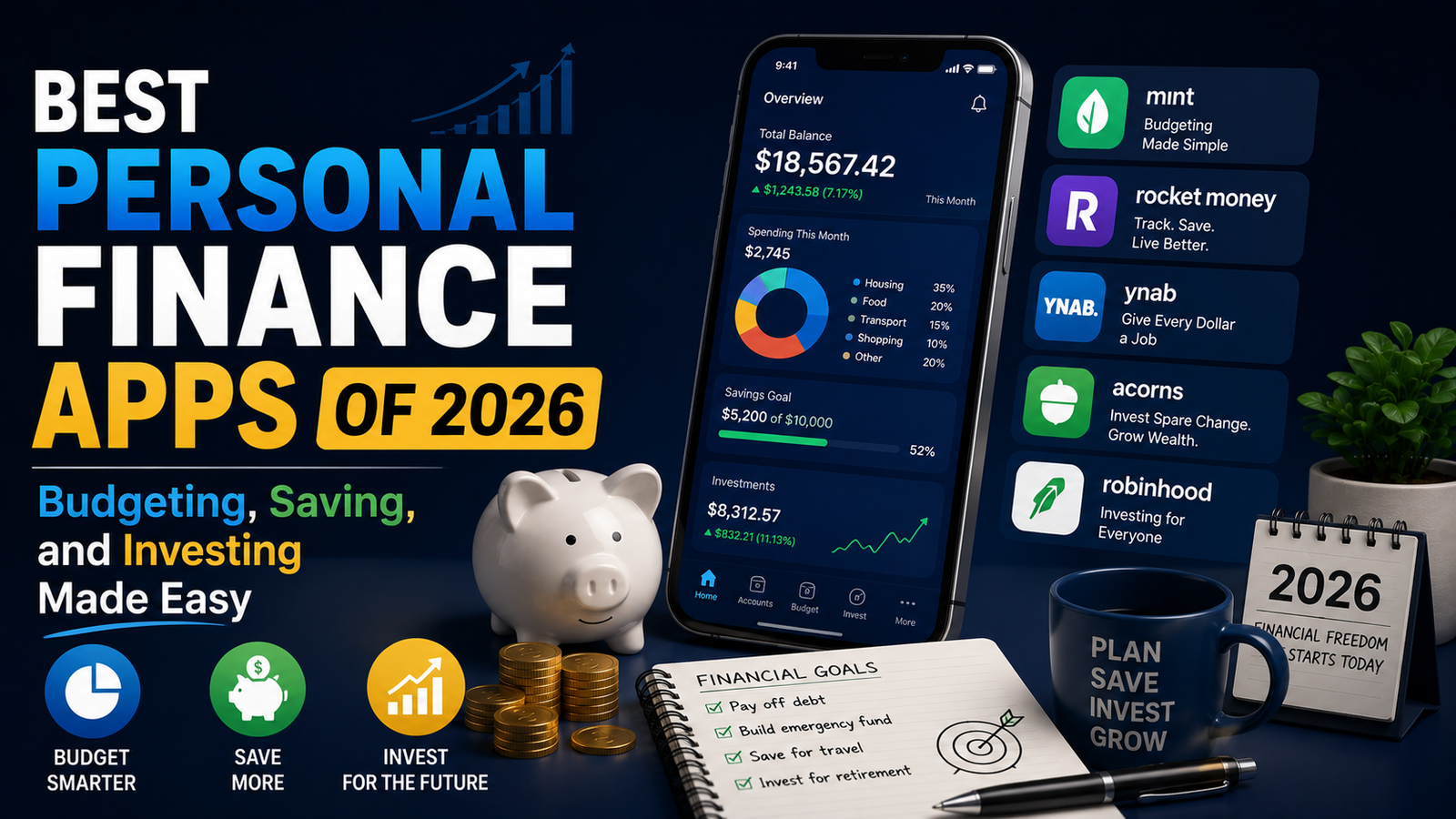
Managing money in America today rarely happens with a paper ledger or a spreadsheet alone anymore. It happens on a phone, through apps that connect directly to bank accounts, categorize spending automatically, forecast upcoming cash flow, and in many cases, use AI to flag problems before they happen. The personal finance app landscape has matured significantly, and 2026 has brought real advances: predictive cash flow forecasting, AI-powered categorization, and deeper investment tracking are now standard expectations rather than premium extras.
With dozens of apps competing for attention, though, picking the right one isn’t always straightforward. Some are built purely for strict, disciplined budgeting. Others focus on investment and net worth tracking. A few try to do everything at once. This guide breaks down the standout personal finance apps of 2026, who each one is genuinely built for, and how to think about choosing between them.
What Changed in Personal Finance Apps by 2026
A few broader shifts have reshaped what “good” looks like in this category. AI-driven transaction categorization and predictive cash flow analysis, which used to be premium differentiators, are now baseline features across most competitive apps. Real-time account syncing across thousands of financial institutions has become standard, and stronger privacy and security expectations — including SOC 2 compliance and bank-level encryption — are now considered table stakes rather than a bonus.
It’s also worth noting that Mint, once one of the most widely used free budgeting apps in the country, was discontinued in recent years, which pushed millions of former users toward newer alternatives. That shift has significantly reshaped which apps dominate this space in 2026.
Best Overall: Quicken Simplifi
For users who want one app that covers budgeting, cash flow forecasting, and investment tracking without needing to juggle multiple tools, Quicken Simplifi has emerged as one of the strongest all-around options in 2026. It connects to more than 14,000 financial institutions and offers a genuinely deep category system, including a three-level category hierarchy with unlimited custom categories, which appeals to users who want granular control over how their spending is organized.
Beyond budgeting, Simplifi includes investment tracking across account types like 401(k)s, IRAs, brokerage accounts, and even crypto holdings, complete with both time-weighted and internal rate of return calculations. Its retirement planner allows users to model up to 15 adjustable variables, and built-in tax category support for IRS Schedules A and B makes year-end tax prep noticeably less painful. At roughly $3.99 per month on an annual plan, it’s priced competitively for the depth of features it offers, and it has picked up recognition from outlets including Engadget, PC Magazine, and Kiplinger in recent years.
Best for: People who want a single, comprehensive app covering budgeting, cash flow forecasting, and investment tracking without paying for multiple separate tools.
Best Free Option: Empower
For users focused primarily on investment tracking and overall net worth visibility, Empower remains one of the strongest free options available in 2026. It allows users to connect a wide range of accounts — investment portfolios across multiple brokerages, 401(k)s, mortgages, 529 college savings plans, and health savings accounts — into a single consolidated dashboard, all at no cost.
Empower includes a genuinely useful suite of free tools: portfolio analysis, a retirement planner, a net worth tracker, a savings planner, debt paydown tools, and an emergency fund tracker. NerdWallet specifically named it the best budget app for tracking wealth and spending in 2026. Its budgeting features are solid but less granular than dedicated budgeting apps like Simplifi or YNAB, making it a better fit for users who prioritize investment and net worth visibility over highly detailed spending categorization.
Best for: Users who want broad financial visibility across investments, retirement accounts, and net worth without paying a subscription fee.
Best for Zero-Based Budgeting: YNAB (You Need A Budget)
YNAB has built a loyal following around its zero-based budgeting philosophy, where every dollar of income is deliberately assigned a job the moment it’s earned, rather than being left unallocated until it’s spent. This approach is specifically designed to help users break the paycheck-to-paycheck cycle and build intentional savings habits, rather than simply tracking where money went after the fact.
For beginners who genuinely struggle with financial discipline or who feel like their money “disappears” without a clear explanation, YNAB’s structured approach tends to produce a more noticeable behavior change than passive tracking apps.
Best for: People who want a proactive, disciplined budgeting system rather than a passive spending tracker.
Best for Reducing Expenses: Rocket Money
Rocket Money takes a different approach from most budgeting apps by actively working to lower a user’s expenses, not just tracking them. The app automatically identifies and tracks recurring subscriptions across linked accounts, and Premium members can cancel unwanted subscriptions directly within the app in just a few taps — a genuinely useful feature given how easy it is for forgotten subscriptions to quietly drain a budget over time.
Best for: Users who suspect they’re overpaying for subscriptions and want a tool that actively helps cut costs, not just monitor them.
Best for Zero-Based Budgeting on a Budget: EveryDollar
Built by Dave Ramsey’s company, Ramsey Solutions, EveryDollar offers another take on zero-based budgeting, relaunched in early 2026 with new features including a “margin finder” tool designed to help users identify extra breathing room in their budget, along with personalized plans and daily lessons.
The free version requires manually entering transactions rather than automatically syncing with bank accounts, which some users find tedious, but others find genuinely useful for building more mindful spending awareness. The premium version adds automatic bank syncing, custom reports, and personalized recommendations based on spending habits.
Best for: Users drawn to Dave Ramsey’s budgeting philosophy, or those who want the option of manual transaction entry for more mindful spending awareness.
Best for Net Worth-Focused Budgeting: PocketGuard
PocketGuard has earned strong ratings on both Android and iOS platforms in 2026, offering a feature set that goes beyond basic budgeting to include net worth tracking, debt payoff planning, bill negotiation, subscription management, and spending insights, along with a built-in personal finance course for users who want to build foundational knowledge alongside using the app itself.
Best for: Users who want budgeting combined with proactive debt payoff planning and bill negotiation tools.
Best for Spreadsheet Lovers: Tiller
For the specific subset of users who actually prefer managing their budget through a spreadsheet rather than a traditional app interface, Tiller offers a unique middle ground. After linking financial accounts, Tiller automatically populates customizable budget templates directly in Google Sheets or Microsoft Excel, combining the automation of a modern finance app with the flexibility and familiarity of spreadsheet-based budgeting.
Best for: Detail-oriented users who want full customization and are already comfortable working in spreadsheets.
Best for Calendar-Based Visualization: CalendarBudget-Style Tools
A growing category of budgeting tools in 2026 has leaned into calendar-based visualization, placing income and expenses directly on the dates they occur, alongside forecasting engines that project future account balances using scheduled transactions and recurring income. This approach is particularly useful for people who think about their finances in terms of specific upcoming dates and bills, rather than abstract monthly totals, helping to visually spot exactly when discretionary spending should be adjusted to avoid overdrafts.
Best for: Visual planners who want to see exactly how upcoming bills and income line up on a calendar, not just a monthly summary.
How to Choose the Right App for You
With this many strong options, the right choice depends less on which app is objectively “best” and more on matching a tool to specific financial habits and goals.
If you want everything in one place — budgeting, investing, retirement planning, and cash flow forecasting — a comprehensive paid app like Quicken Simplifi is likely to offer the best long-term value despite the modest subscription cost.
If cost is the primary concern and your main goal is visibility into net worth and investments, a free tool like Empower delivers substantial value without a subscription fee, though its budgeting features are less detailed than dedicated budgeting apps.
If you’ve struggled with budgeting discipline in the past, a zero-based budgeting app like YNAB or EveryDollar is specifically designed to build the kind of intentional, proactive money habits that passive tracking apps don’t reliably create on their own.
If subscription creep is a known problem for you, an app like Rocket Money that actively identifies and helps cancel unwanted recurring charges can pay for itself quickly.
If you’re a spreadsheet person at heart, don’t force yourself into an unfamiliar app interface — a tool like Tiller that automates data into a spreadsheet you already understand may lead to more consistent long-term use than a flashier app you eventually abandon.
What to Look for Regardless of Which App You Choose
A few practical considerations apply no matter which app ultimately fits your needs best.
Security should never be an afterthought. Look specifically for SOC 2 compliance, bank-level encryption, and clear, transparent data retention policies before linking sensitive financial accounts to any app.
Free doesn’t always mean lower quality, and paid doesn’t always mean better. Several of the strongest options in 2026, including Empower, are free, while some paid apps justify their cost through genuinely differentiated features like advanced tax categorization or debt payoff planning. The right evaluation is feature-fit, not price alone.
The best app is the one you’ll actually use consistently. Even the most feature-rich, highly rated app provides little value if its interface or approach doesn’t match how you naturally think about money. It’s worth trying the free tier or free trial of a few different apps before committing to a paid subscription long-term.
Switching platforms has gotten easier. Most modern personal finance apps offer streamlined onboarding with automated account linking and transaction categorization, meaning the fear of a difficult migration shouldn’t be a major barrier to switching if your current app isn’t working well for you.
The Bottom Line
Personal finance apps in 2026 have evolved well beyond simple expense trackers into genuinely powerful tools for budgeting, investing, and long-term financial planning, often rivaling features that used to require a paid financial advisor. Whether the priority is disciplined zero-based budgeting, free investment tracking, subscription management, or an all-in-one comprehensive platform, there’s a strong, well-reviewed option available for nearly every financial habit and goal.
The most important step isn’t necessarily finding the single “best” app on any list — it’s finding the one that fits naturally enough into daily life that it actually gets used consistently. A good app used inconsistently will always underperform a decent app used every week.