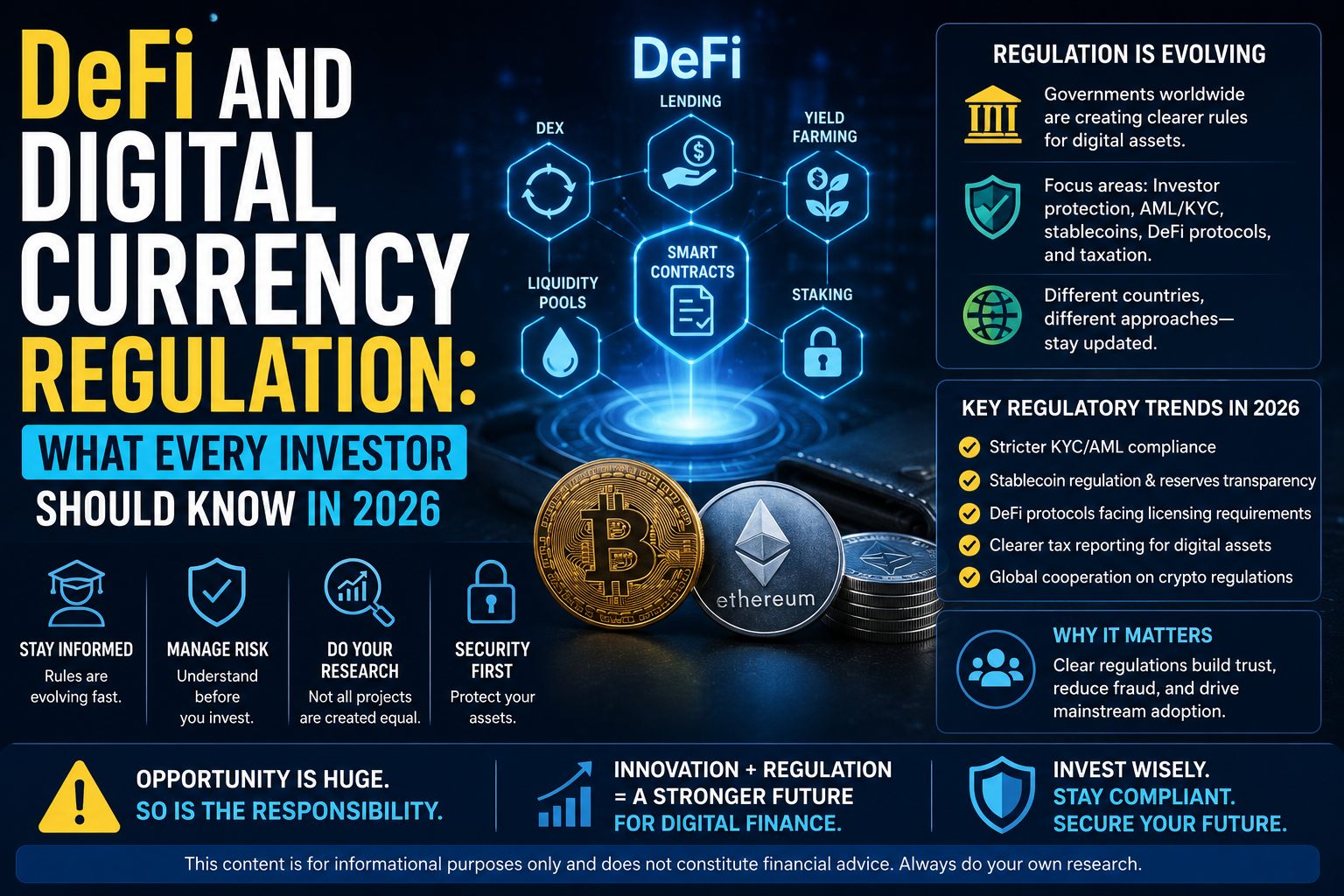
For years, cryptocurrency and decentralized finance in the United States operated in a genuine legal gray zone — technically legal, but without clear federal rules on how digital assets should be classified, taxed, or overseen. That era is coming to a close. 2026 has emerged as the pivotal year when U.S. crypto regulation shifted from years of legislative debate into real, enforceable rules, fundamentally changing what American investors need to understand before putting money into digital assets.
Whether you’re holding Bitcoin, using a stablecoin for everyday transactions, or exploring DeFi lending protocols for yield, the regulatory ground has shifted meaningfully beneath your feet. This guide breaks down what’s actually changed, what it means practically for investors, and what to watch for as implementation continues throughout the year.
The GENIUS Act: America’s First Major Stablecoin Law
The single biggest regulatory development shaping U.S. crypto policy in 2026 is the GENIUS Act — formally the Guiding and Establishing National Innovation for U.S. Stablecoins Act. Signed into law in July 2025 after passing both chambers of Congress with notable bipartisan support, the GENIUS Act represents the first comprehensive federal framework specifically governing stablecoins, the category of cryptocurrency designed to maintain a stable value by being pegged to a reserve asset like the U.S. dollar.
The law’s core requirements are significant. Permitted stablecoin issuers must back their tokens on a strict one-to-one basis using U.S. dollars or other similarly liquid, low-risk assets. Issuers are required to publicly disclose their redemption policies and publish monthly details of their reserves, creating a level of transparency that much of the stablecoin market previously lacked. Issuers can choose to operate under federal or state regulatory oversight, though state-level regulation is limited to issuers with $10 billion or less in stablecoins outstanding — meaning the largest players are effectively required to operate under federal supervision.
Perhaps most notably for everyday holders, the law establishes that stablecoin holders’ claims receive priority status in the event an issuer becomes insolvent, placing stablecoin holders ahead of most other creditors — a meaningful consumer protection that didn’t previously exist in any consistent form.
Where Implementation Stands
As of mid-2026, the GENIUS Act has moved from legislation into active rulemaking. The Treasury Department has been working toward finalizing implementing rules, with multiple federal agencies — including the OCC, FDIC, and CFTC — involved in shaping the specific regulatory requirements issuers must meet. The Treasury’s Financial Crimes Enforcement Network (FinCEN) and the Office of Foreign Assets Control (OFAC) have jointly proposed rules specifically addressing anti-money laundering and sanctions compliance requirements for permitted stablecoin issuers, treating them similarly to traditional financial institutions for these purposes.
Practically, this means the stablecoin market is in the middle of a significant transition. Non-compliant stablecoins are expected to face growing pressure to either exit the U.S. market or convert into GENIUS Act-compliant versions as the rulemaking deadline approaches, creating a meaningful compliance cliff for issuers who haven’t adapted.
A Landmark Classification: Is Crypto a Security or a Commodity?
For years, one of the most consequential unresolved questions in U.S. crypto regulation was surprisingly basic: are major cryptocurrencies like Bitcoin and Ethereum legally classified as securities, subject to SEC oversight, or as commodities, subject to CFTC oversight? This distinction matters enormously, since securities and commodities are regulated under very different legal frameworks with different disclosure requirements, trading rules, and investor protections.
In March 2026, the SEC and CFTC jointly resolved this long-standing ambiguity, publishing a joint interpretive framework that classified a specific list of major digital assets — including Bitcoin, Ethereum, Solana, XRP, Cardano, Litecoin, Dogecoin, and several others — as digital commodities falling under CFTC jurisdiction rather than SEC securities jurisdiction.
This classification decision provides significant regulatory clarity that the crypto industry had been requesting for years. For investors, it means these specific assets are now regulated under commodities law rather than the more stringent securities framework, which affects everything from how exchanges must operate to what disclosure and registration requirements apply to trading platforms.
The DeFi Yield Dilemma: A New Two-Tier Market
One of the more interesting practical consequences of the GENIUS Act relates to yield — the interest or returns investors can earn on their stablecoin holdings. Under the new federal framework, GENIUS Act-compliant stablecoin issuers are generally expected to offer minimal or zero yield to holders in exchange for the safety and regulatory protection of operating under federal oversight, since paying yield directly could trigger securities regulations the law was designed to avoid.
Meanwhile, decentralized finance lending protocols built on networks like Ethereum and Solana continue to offer meaningfully higher yields, in the range of 5% to 8% annually on stablecoin deposits, but they operate outside the regulated banking and stablecoin framework entirely.
This dynamic is creating what industry analysts describe as a fracturing of the stablecoin market into two distinct tiers: federally regulated, insured-adjacent stablecoins offering safety and legal clarity but little to no yield, versus DeFi-based stablecoin lending that offers meaningfully higher returns but without the same regulatory protections, deposit insurance, or legal certainty in the event something goes wrong.
For investors, this means the old assumption of simply parking stablecoins wherever the yield is highest now comes with a much clearer tradeoff to evaluate: regulatory safety and legal clarity, versus higher yield with meaningfully higher counterparty and platform risk.
What This Means Practically for American Investors
Given how quickly the regulatory landscape has shifted, a few practical action items are worth understanding for anyone holding or considering digital assets.
Know What You Actually Hold
With stablecoin regulation now creating a meaningful distinction between compliant and non-compliant issuers, it’s worth understanding exactly which stablecoins you hold, which issuer backs them, and whether that issuer is on a path toward federal compliance. Holdings in non-compliant stablecoins may face increasing platform restrictions or conversion requirements as enforcement deadlines approach throughout 2026.
Understand That “No Deposit Insurance” Still Applies
Despite the new regulatory framework significantly increasing oversight of stablecoin issuers, it’s important to understand that stablecoin holdings are still fundamentally different from a bank deposit. Regulatory guidance has clarified that FDIC deposit insurance does not extend to stablecoin token holders, meaning the priority-claim protection in bankruptcy under the GENIUS Act, while meaningful, is not the same as the deposit insurance protection that applies to a traditional bank account.
Evaluate the Yield-for-Safety Tradeoff Deliberately
If you currently rely on meaningful yield from stablecoin lending — for example, 4% or higher annual returns — it’s worth recognizing that fully compliant federal stablecoins are unlikely to offer comparable yield going forward. Investors who genuinely need that yield will likely need to consciously choose to hold assets in less-regulated DeFi platforms, understanding clearly that this comes with materially higher risk, rather than assuming all stablecoin options now carry the same level of protection.
Watch State-Level Regulation, Not Just Federal Rules
Regulation isn’t happening only at the federal level. States including California have moved forward with their own comprehensive digital asset licensing frameworks, such as California’s Digital Financial Assets Law, which establishes state-level licensing and oversight requirements for digital asset businesses operating within the state. Depending on where you live and which platforms you use, state-level rules may layer on top of, or interact with, the federal framework in ways that affect which platforms remain available to you.
Understand the New Securities vs. Commodities Distinction
With the SEC and CFTC’s joint classification framework now in place, it’s worth understanding that not all cryptocurrencies are treated identically under the law. Assets classified as digital commodities fall under a different regulatory regime than tokens that may still be treated as securities, which can affect everything from what disclosures a platform must provide to what legal recourse investors have if something goes wrong.
Why This Regulatory Shift Matters Beyond Crypto Enthusiasts
Even for investors who have no direct interest in cryptocurrency, this regulatory shift matters for a broader reason: stablecoins are increasingly functioning as a genuine bridge between traditional finance and the broader financial system. Major payment platforms have been actively exploring stablecoin integration into everyday payment infrastructure, meaning the regulatory clarity established by the GENIUS Act could accelerate stablecoins moving from a crypto-native tool into a more mainstream part of how Americans send and receive money, pay for goods, or move funds across borders.
This mainstream integration is precisely why the regulatory framework matters so much right now. A poorly regulated stablecoin market poses meaningfully different risks when stablecoins are used primarily by crypto traders, compared to a scenario where they become integrated into everyday consumer payment systems used by people with little awareness of the underlying technology or its risks.
Key Risks That Remain, Even With New Regulation
It’s important not to overstate how much the new regulatory framework eliminates risk in this space. Several meaningful risks remain for investors to keep in mind.
Regulatory implementation is still incomplete. Much of the GENIUS Act’s practical impact depends on final rules still being developed by multiple federal agencies throughout 2026, meaning some specific requirements and their real-world effects remain genuinely uncertain until finalized.
DeFi platforms remain largely outside this new framework. The GENIUS Act specifically addresses stablecoin issuance, not the broader universe of decentralized finance lending, trading, and yield-generating platforms, which continue to operate with far less regulatory oversight and correspondingly higher risk.
Global regulatory fragmentation continues. While the U.S. framework is maturing, other major jurisdictions like the European Union have their own distinct regulatory frameworks, creating a genuinely fragmented global landscape that can create compliance complexity for platforms and uncertainty for investors using cross-border services.
Volatility and platform risk haven’t disappeared. Beyond stablecoins specifically, the broader cryptocurrency market, including assets now classified as digital commodities, remains subject to significant price volatility and platform-specific risks that no regulatory classification framework eliminates entirely.
The Bottom Line
2026 marks a genuine turning point for U.S. digital asset regulation, moving the country from years of legislative uncertainty into an active, if still incomplete, regulatory framework. The GENIUS Act’s stablecoin rules, combined with the SEC and CFTC’s joint classification of major cryptocurrencies as digital commodities, represent the most significant regulatory clarity the U.S. crypto market has seen to date.
For investors, this shift creates both opportunity and new considerations to navigate. Regulated stablecoins now offer meaningfully more legal clarity and consumer protection than in years past, but often at the cost of the yield that drew many investors to stablecoin lending in the first place. Understanding exactly what you hold, where it sits within this new regulatory landscape, and what tradeoffs you’re accepting between safety and yield has become essential homework for any American investor engaging with digital assets in 2026 — homework that simply didn’t have clear answers just a year or two ago.