Albert Einstein reportedly once called compound interest the eighth wonder of the world, adding that those who understand it earn it, and those who don’t, pay it. Whether or not he actually said it, the sentiment holds up remarkably well. Compound interest is arguably the single most powerful force in personal finance — quietly responsible for turning modest, consistent savings into real wealth over time, and just as capable of turning manageable debt into an overwhelming burden when it works against you.
Despite how central this concept is to nearly every major financial decision Americans make — from retirement accounts to credit card debt — it remains one of the most misunderstood ideas in personal finance. This guide breaks down exactly how compound interest works, introduces the simple mental shortcut known as the Rule of 72, and shows how these concepts play out in real financial decisions Americans face today.
What Compound Interest Actually Is
At its core, compound interest is interest calculated not just on your original amount of money, but also on the interest that money has already earned. This is fundamentally different from simple interest, which is calculated only on the original principal amount, year after year, with no growth on top of previously earned interest.
Here’s a simple way to see the difference. If you deposit $1,000 into an account earning 5% simple interest annually, you’d earn exactly $50 every single year, with no acceleration — $50 in year one, $50 in year two, and so on indefinitely. With compound interest at the same 5% rate, you’d earn $50 in year one, but in year two, you’d earn 5% on $1,050, not just the original $1,000 — meaning your interest itself starts earning interest. That small difference seems trivial in year two, but it becomes genuinely transformative over long periods of time.
This is the essence of what makes compound interest so powerful: it creates a snowball effect, where growth builds on previous growth, accelerating over time rather than staying flat.
The Rule of 72: A Simple Mental Shortcut
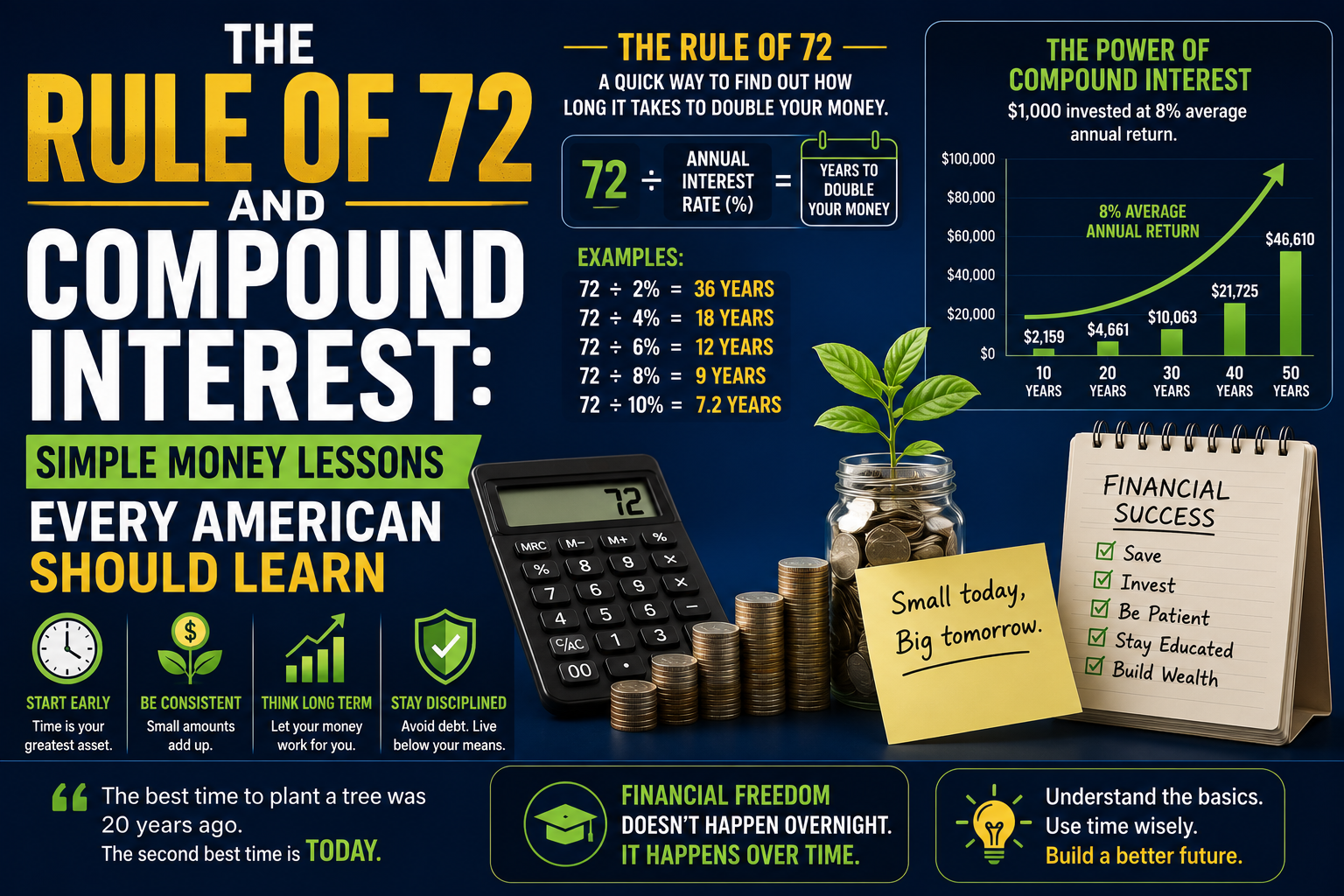
One of the most useful tools for understanding compound interest doesn’t require a calculator or a spreadsheet — just simple division. The Rule of 72 is a quick mental math shortcut that estimates how many years it will take for an investment to double in value at a given annual rate of return.
The formula is straightforward: divide 72 by the annual interest rate (expressed as a whole number, not a decimal), and the result gives you an approximate number of years for your money to double.
For example, at a 6% annual return, dividing 72 by 6 gives you 12 — meaning your money would take roughly 12 years to double. At a 9% annual return, 72 divided by 9 equals 8, meaning your investment would double in approximately 8 years. At a lower 3% return, the doubling time stretches out to roughly 24 years.
This shortcut isn’t perfectly precise — the actual math behind compound growth involves logarithms — but it’s remarkably accurate for typical interest rates between roughly 6% and 10%, which makes it genuinely useful for quick, real-world financial estimates without needing a financial calculator.
Why This Matters: Real Numbers From Today’s Financial Landscape
Understanding compound interest in the abstract is one thing. Seeing how dramatically it plays out with real, current numbers makes the concept far more tangible.
The Power of Time in Long-Term Investing
Consider a hypothetical $10,000 investment earning a 7% average annual return, a reasonable long-term assumption for a diversified stock portfolio over multi-decade periods. Left to grow for 30 years without any additional contributions, that initial $10,000 would grow to over $76,000 — more than seven times the original investment, without a single additional dollar ever being added. That growth isn’t linear; it accelerates significantly in the later years precisely because of compounding.
This illustrates why financial advisors consistently emphasize starting to invest as early as possible, even in small amounts. The actual dollar amount contributed early in life often matters less than how many years that money has to compound.
The Disappointing Reality of Basic Savings Accounts
Compound interest isn’t automatically powerful — it depends heavily on the interest rate involved, and this is where many Americans unknowingly miss out on growth. As of mid-2026, the national average savings account interest rate sits at roughly 0.4% to 0.6% APY, according to FDIC and Bankrate data. At that rate, the Rule of 72 tells a sobering story: dividing 72 by 0.5 suggests it would take a staggering 144 years for money sitting in an average savings account to double.
By contrast, high-yield savings accounts, typically offered by online banks, have been paying meaningfully more — often in the 4% to 5% APY range throughout 2026. At 4.5% APY, the Rule of 72 estimates a doubling time of roughly 16 years, a dramatically different outcome from a standard account, even though both are technically “savings accounts” earning compound interest.
This gap illustrates a genuinely actionable lesson: where you keep your money matters enormously, even when the underlying mechanism, compound interest, is identical. Simply moving savings from an average traditional bank account to a competitive high-yield account can meaningfully change how quickly that money grows, without taking on any additional investment risk.
Compound Interest Works Against You With Debt, Too
The same mathematical principle that builds wealth in a savings or investment account can work in the opposite direction with debt, particularly high-interest debt like credit cards. If a credit card balance carries a 20% or higher annual percentage rate, and only minimum payments are made, compound interest accrues on the growing balance in the same accelerating way it would in a savings account, just in a direction that costs money rather than builds it.
This is why financial experts consistently emphasize paying off high-interest debt as one of the first priorities in any financial plan. Paying off a credit card charging 24% interest is often described as effectively earning a guaranteed 24% return, since eliminating that compounding cost is mathematically equivalent to earning that rate on an investment, without any of the market risk involved in actual investing.
How Compound Interest Shapes Retirement Planning
Nowhere does compound interest matter more than in retirement planning, where the multi-decade time horizon allows its effects to fully play out.
Tax-advantaged retirement accounts like 401(k)s and Roth IRAs are specifically structured to maximize the benefit of compound growth over time. A Roth IRA, for example, allows contributions to grow completely tax-free, meaning investment gains compound year after year without any annual tax drag reducing the growth, and qualified withdrawals in retirement aren’t taxed at all. For 2026, the Roth IRA contribution limit stands at $7,500 annually, or $8,600 for those age 50 and older, giving savers a meaningful annual opportunity to put money into an account built specifically to take full advantage of long-term compounding.
The practical lesson for retirement savers is straightforward but often underappreciated: because compound growth accelerates significantly in later years, starting retirement contributions even a few years earlier can have an outsized impact on the final account balance, often far more significant than contributing larger amounts later but starting later in life.
A Practical Order of Operations for Using Compound Interest Wisely
Financial planners commonly recommend a general sequence for prioritizing money, specifically designed around how compound interest works for and against different financial goals.
First, eliminate high-interest debt. Since compound interest on credit card debt often exceeds what any low-risk investment could realistically earn, paying down high-interest balances typically offers the best guaranteed “return” available before pursuing other financial goals.
Second, build an emergency fund. Keeping three to six months of essential expenses in an accessible, ideally high-yield, savings account provides a financial cushion, ensuring that unexpected expenses don’t force high-interest borrowing that would undo the benefits of compound growth elsewhere.
Third, maximize tax-advantaged retirement contributions. Contributing enough to capture any available employer 401(k) match, then contributing to accounts like Roth IRAs, takes full advantage of both compound growth and favorable tax treatment over long time horizons.
Fourth, invest additional savings toward other goals. Once high-interest debt is eliminated and tax-advantaged retirement savings are prioritized, additional money can be directed toward other investment goals, continuing to benefit from long-term compounding.
This order isn’t arbitrary — it’s specifically designed to minimize the negative compounding effects of debt while maximizing the positive compounding effects of long-term, tax-advantaged investing.
Common Misunderstandings About Compound Interest
A few misconceptions about compound interest are worth clearing up directly.
“A slightly higher interest rate doesn’t make much difference.” In reality, seemingly small differences in annual rate of return compound into dramatically different outcomes over long time horizons. The difference between a 5% and 7% average annual return, compounded over 30 years, can amount to tens of thousands of dollars in additional growth on even a modest initial investment.
“It’s not worth starting with a small amount.” Because compound growth accelerates over time, starting early with a modest amount often outperforms starting later with a larger amount, simply because the smaller amount has more years to compound.
“Compounding frequency doesn’t matter much.” Whether interest compounds daily, monthly, or annually does make a real difference over time, though usually a smaller one than the underlying interest rate itself. Accounts that compound more frequently will generally produce slightly higher effective returns than those compounding less often, even at the same stated annual rate.
The Bottom Line
Compound interest is one of those rare financial concepts that’s simple enough to explain in a single sentence, yet powerful enough to fundamentally shape someone’s entire financial future, for better or worse. The Rule of 72 offers a genuinely useful shortcut for quickly estimating its real-world impact, whether you’re evaluating how fast a retirement account might grow or how quickly an unpaid credit card balance could snowball into a serious problem.
The core, actionable lesson is remarkably consistent across every example: time and interest rate are the two variables that matter most, and both are, at least partially, within your control. Starting early, even with modest amounts, and actively seeking better interest rates on savings while aggressively minimizing high-interest debt, are two of the most straightforward and mathematically proven ways to make compound interest work firmly in your favor rather than against you.