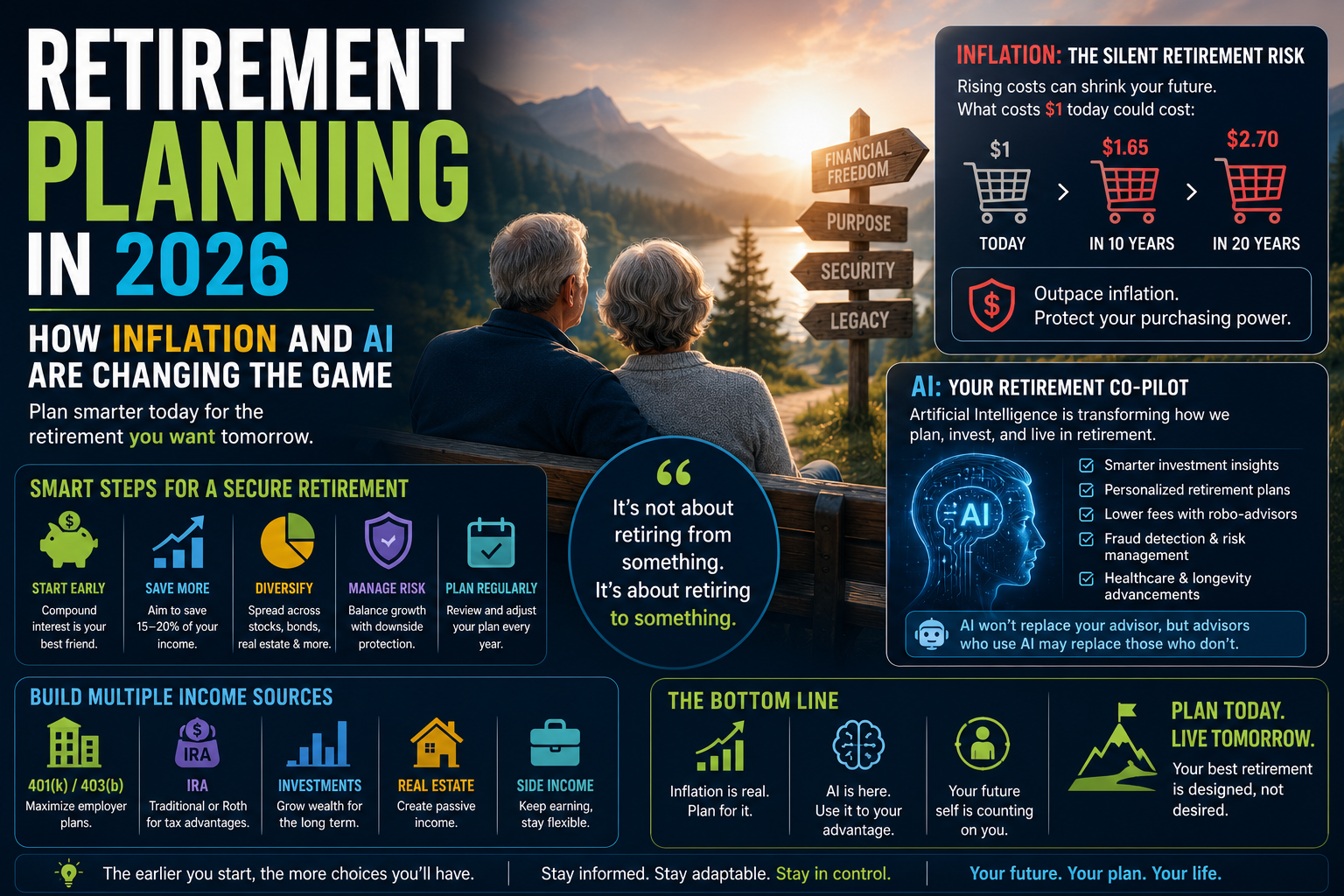
Retirement planning in America has never been static, but 2026 brings a particularly notable mix of changes worth understanding. Higher contribution limits are giving savers more room to build their nest egg. A modest Social Security cost-of-living adjustment is helping benefits keep pace with rising prices, if only partially. New tax provisions are reshaping the math for higher earners. And artificial intelligence is quietly becoming a genuine tool in how everyday Americans plan for their financial future, even as a significant share of people report delaying retirement altogether due to financial pressure.
This guide breaks down exactly what’s changed for retirement planning in 2026, what it means practically, and how inflation and AI are both reshaping the landscape in different but equally important ways.
More Room to Save: The 2026 Contribution Limit Increases
The IRS announced meaningful increases to retirement account contribution limits for 2026, giving savers more room to shelter income from taxes while building long-term wealth.
The employee deferral limit for 401(k), 403(b), and most 457(b) plans increased to $24,500 for 2026, up $1,000 from $23,500 in 2025. The total combined limit for these plans, including employer matches and other contributions, rose to $72,000. For workers age 50 and older, the standard catch-up contribution increased to $8,000, up from $7,500, allowing those savers to contribute a maximum of $32,500 for the year. The “super catch-up” provision for workers specifically aged 60 to 63, introduced under the SECURE 2.0 Act, remains at $11,250, allowing a total contribution of $35,750 for those in that narrow age band.
IRA contribution limits also increased, rising to $7,500 for 2026, up from $7,000 the year before. Income phase-out ranges for deducting traditional IRA contributions and for contributing to Roth IRAs were adjusted upward as well, giving moderate and higher earners slightly more room before those tax benefits begin to phase out.
According to financial planning professionals, these increases matter beyond just the raw dollar figures — they help retirement savers keep pace with both rising incomes and inflation, while also providing an opportunity to reduce taxable income during peak earning years. That said, it’s worth noting that only a relatively small percentage of 401(k) participants actually max out their contributions each year, meaning these higher limits primarily benefit higher-income savers who have the cash flow to take full advantage of them.
A Significant Tax Change for Higher Earners
Beyond the standard contribution limit increases, 2026 brings a specific and, according to several financial planners, particularly impactful change for higher-income workers related to catch-up contributions.
Under provisions tied to the SECURE 2.0 Act, workers age 50 and older whose prior-year Social Security wages exceeded a certain threshold are now required to direct their catch-up contributions into a Roth account rather than a traditional pre-tax account. This is a meaningful shift for affected higher earners, since it eliminates the immediate current-year tax deduction they previously received on those catch-up contributions, even though it offers the long-term benefit of tax-free growth and withdrawals in retirement.
Financial planners have specifically flagged this as one of the more consequential changes for 2026, encouraging higher-income savers approaching this threshold to work with an advisor to understand how the shift affects their near-term tax planning versus their long-term retirement tax strategy.
Social Security: A Modest Cost-of-Living Adjustment
For current retirees and those approaching retirement, Social Security’s annual cost-of-living adjustment (COLA) remains one of the most closely watched retirement-related figures each year, since it directly determines whether benefits keep pace with inflation.
For 2026, the Social Security Administration announced a 2.8% COLA increase to monthly benefits, slightly higher than the previous year’s 2.5% adjustment. For the average single retiree, this translates to an increase of roughly $56 per month, bringing the average monthly benefit to approximately $2,071, or about $24,852 annually.
While any COLA increase helps retirees maintain purchasing power, a 2.8% adjustment on a benefit averaging roughly $2,071 a month underscores a point retirement planners consistently emphasize: Social Security alone is rarely sufficient to fully fund a comfortable retirement for most Americans, reinforcing the importance of personal retirement savings through vehicles like 401(k)s and IRAs.
Separately, the Social Security Wage Base — the maximum amount of earnings subject to Social Security payroll tax — increased by $8,400 to $184,500 for 2026, meaning higher earners will pay Social Security tax on a larger portion of their income than in previous years.
Inflation’s Ongoing Squeeze on Retirement Confidence
Even with higher contribution limits and a positive COLA adjustment, inflation continues to weigh heavily on how Americans feel about their retirement prospects. According to a recent national survey, more than a third of U.S. adults report that they have delayed, or plan to delay, their retirement, with insufficient savings and inflation cited as the two most common reasons.
This finding highlights an important nuance: policy changes like higher contribution limits are helpful, but they only benefit people who are actually in a financial position to take advantage of them. For a meaningful share of Americans already feeling squeezed by the cost of living, the ability to contribute more to a 401(k) matters less than the more basic challenge of having enough discretionary income to save consistently in the first place.
This tension between technically improved savings opportunities and the practical reality of inflation-driven financial strain is one of the defining dynamics of retirement planning heading into 2026, and it’s a gap that pure policy adjustments haven’t fully closed.
Where AI Is Starting to Genuinely Reshape Retirement Planning
Alongside these policy and inflation-driven shifts, artificial intelligence has emerged as a meaningful new factor in how Americans approach retirement planning, though its role remains more of a supplement than a replacement for traditional planning tools.
AI as a Retirement Planning Starting Point
A growing share of Americans are using AI chatbots to get a general understanding of retirement concepts, model basic savings scenarios, or ask questions they might otherwise feel embarrassed to ask a financial professional. National surveys have found that AI use in personal finance is closely correlated with overall financial literacy, and retirement planning specifically is one of the more commonly cited use cases, alongside budgeting and investment questions.
This can genuinely help close a real knowledge gap. Research has consistently shown that retirement fluency — understanding concepts like Medicare coverage, long-term care probability, and how much monthly savings is realistically needed — remains alarmingly low among U.S. adults. AI tools that make these concepts more approachable and less intimidating to ask about can serve a genuinely useful educational function.
Where AI Retirement Advice Falls Short
At the same time, independent testing of AI chatbots on realistic retirement planning scenarios has revealed a consistent pattern: the advice tends to be technically reasonable but often unrealistic once real-world constraints are considered. In one widely cited test, an AI chatbot asked to help a 50-year-old couple with $100,000 saved catch up on retirement recommended saving over $30,000 annually, without first asking about their income or the reasons behind their current savings level, an unworkable target for most households at that stage of life.
This illustrates a core limitation that remains true even as AI tools improve: retirement planning inherently involves deeply personal variables, income stability, health considerations, family obligations, risk tolerance, that a chatbot can’t fully account for without extensive, carefully provided context, and even then, may still oversimplify.
The Rise of AI-Integrated Financial Platforms
2026 has also seen the emergence of more sophisticated AI-powered financial planning tools that go beyond simple chatbot conversations. Some major platforms have introduced AI advisory features that can securely connect to a user’s actual financial accounts, providing more personalized, context-aware guidance based on real account balances and spending patterns rather than generic, hypothetical scenarios. Additionally, several major investment platforms have rolled out hybrid advisory models that combine algorithmic portfolio management with access to human Certified Financial Planners specifically for complex retirement decisions like Social Security timing or Roth conversion strategy.
This hybrid approach reflects a broader, more realistic understanding of where AI genuinely adds value in retirement planning, handling data organization, basic projections, and general education efficiently, while reserving nuanced, high-stakes decisions for human judgment, whether from a financial professional or the individual themselves after being better informed.
Practical Steps for Retirement Planning in 2026
Given this combination of policy changes, inflation pressure, and evolving technology, a few practical priorities stand out for Americans planning for retirement this year.
Review your contribution rate against the new limits. Even a modest increase in contribution percentage can meaningfully benefit from the higher 2026 limits, particularly for savers who haven’t adjusted their contribution rate in a few years.
Understand whether the new Roth catch-up rule affects you. Higher-income workers age 50 and older should specifically confirm whether their catch-up contributions are now required to go into a Roth account, since this changes near-term tax planning even though it may benefit long-term tax-free growth.
Don’t rely on Social Security COLA increases to offset inflation alone. With the 2026 adjustment set at 2.8%, retirees and near-retirees should evaluate whether their overall retirement income plan, not just Social Security, is realistically keeping pace with their actual cost of living.
Use AI tools as a starting point, not a final plan. AI chatbots can be genuinely useful for building basic retirement literacy and modeling simple scenarios, but specific numbers and strategies should be verified against a licensed financial professional, particularly for complex decisions like Social Security claiming age or Roth conversion strategy.
Revisit your plan if you’ve considered delaying retirement due to inflation. For the substantial share of Americans currently planning to delay retirement due to insufficient savings or inflation concerns, working with a financial professional to stress-test different scenarios, including partial retirement or phased withdrawal strategies, may reveal more flexible options than an all-or-nothing delay.
The Bottom Line
Retirement planning in 2026 sits at an interesting intersection of genuine improvement and persistent challenge. Higher contribution limits, a positive Social Security COLA, and increasingly capable AI tools all represent real, tangible progress for savers who are positioned to take advantage of them. At the same time, inflation continues to erode retirement confidence for a significant share of Americans, and AI, while increasingly useful as an educational starting point, still falls meaningfully short of replacing personalized, professional retirement guidance for complex, high-stakes decisions.
The most effective approach for 2026 combines taking full advantage of the expanded savings opportunities the IRS has provided, staying realistic about what Social Security alone can and can’t cover, and treating AI tools as a genuinely useful supplement, rather than a substitute, for thoughtful, personalized retirement planning.