Few numbers in American financial life carry as much weight, or generate as much confusion, as the three-digit credit score. It quietly influences whether you get approved for a mortgage, what interest rate you pay on a car loan, whether you qualify for the best credit card rewards, and sometimes even whether you land an apartment lease or a job offer. Yet despite how consequential it is, credit scores remain surrounded by persistent myths that cause Americans to make costly, unnecessary financial decisions.
Some of these misconceptions are decades old and simply won’t die. Others have emerged more recently as scoring models and credit reporting rules have genuinely evolved. This guide separates fact from fiction, using current 2026 data and expert guidance, so you can make credit decisions based on how scoring actually works, not on outdated assumptions.
Myth: Checking Your Own Credit Score Will Lower It
This is, by a wide margin, the most persistent and widely believed credit myth in America. Multiple industry surveys have found that despite the vast majority of consumers being aware of their credit score, this exact misconception remains one of the most common reasons people avoid checking it regularly.
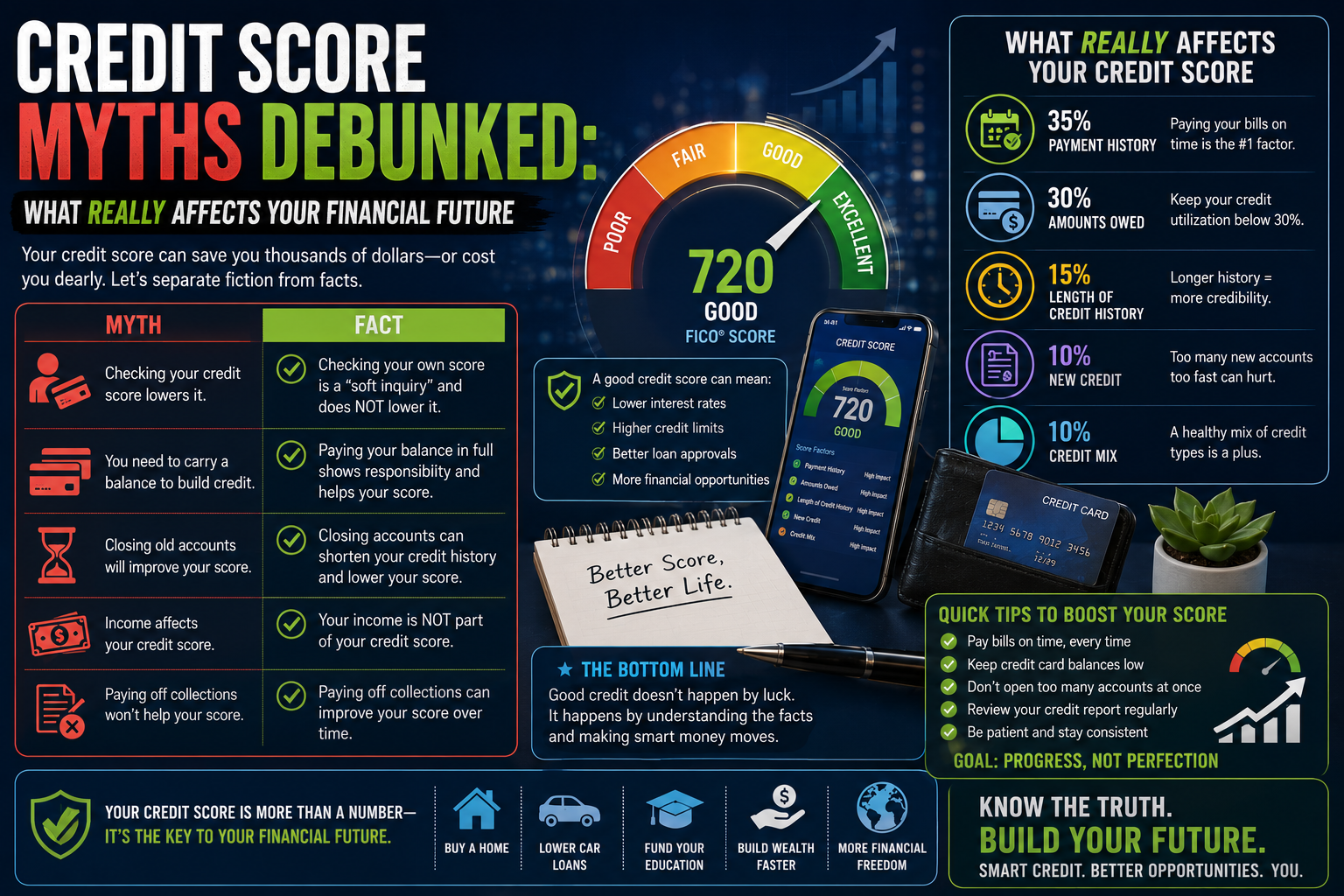
The fact: Checking your own credit score or report is classified as a “soft inquiry,” and soft inquiries have zero impact on your FICO or VantageScore. This is confirmed consistently by the Consumer Financial Protection Bureau (CFPB) and all three major credit bureaus — Experian, Equifax, and TransUnion.
What actually affects your score is a “hard inquiry,” which occurs specifically when a lender checks your credit because you’ve applied for new credit, such as a mortgage, auto loan, or new credit card. Hard inquiries can cause a small, temporary dip in your score, but checking your own credit through your bank, a free credit monitoring service, or AnnualCreditReport.com never falls into this category. In fact, regularly monitoring your own credit is one of the most useful habits for catching errors or fraud early, precisely because it carries no risk to your score.
Myth: Your Income Affects Your Credit Score
It seems intuitive that earning more money would translate into a higher credit score, but this assumption doesn’t reflect how credit scoring actually works.
The fact: Income is not a factor in either FICO or VantageScore calculations. Credit scores are based entirely on credit-related data: payment history, amounts owed, length of credit history, new credit inquiries, and credit mix. A high earner with a pattern of missed payments or maxed-out credit cards can have a low score, while someone with a modest income but a consistent history of on-time payments and responsible credit use can have an excellent one.
This doesn’t mean income is irrelevant to borrowing entirely — lenders often consider income separately, alongside your credit score, when evaluating your debt-to-income ratio for a specific loan application. But the actual three-digit score itself has no direct relationship to how much money you make.
Myth: Carrying a Small Balance Instead of Paying in Full Helps Your Score
This is a particularly costly myth, since believing it can lead people to unnecessarily pay interest charges they didn’t need to pay.
The fact: Carrying a balance on your credit card from month to month does not improve your credit score, and it never has. What actually matters for the “amounts owed” portion of your score, roughly 30% of your FICO score, is your credit utilization ratio: how much of your available credit you’re using at any given time, regardless of whether you carry that balance forward or pay it off in full each month.
Paying your statement balance in full every month is both financially smarter, since it avoids interest charges entirely, and just as beneficial to your credit score as carrying a balance would be, if not more so, since lower utilization is generally viewed favorably by scoring models.
Myth: A Low Credit Score Will Haunt You Forever
Many people assume that a period of credit trouble, whether from a missed payment, high debt, or even a more serious event like a collections account, will permanently damage their financial standing.
The fact: According to credit scoring experts, a credit score is essentially a snapshot of risk at a particular point in time, not a permanent judgment. Scores change as new information is added to your credit file, and the impact of past credit problems diminishes as time passes and more recent positive behavior accumulates. Someone who experienced a period of financial difficulty several years ago, but has since built a consistent record of on-time payments, will generally see their score reflect that improved, more recent behavior far more heavily than older, negative history.
This is genuinely good news for anyone recovering from a past financial setback: consistent, responsible credit behavior going forward has real, measurable power to rebuild a damaged score over time.
Myth: There’s Only One Credit Score That Matters
Many consumers assume they have a single, universal credit score that every lender sees identically. This isn’t accurate, and misunderstanding it can lead to confusion when different sources report different numbers.
The fact: There are multiple credit scoring models in active use, including several versions of the FICO Score and multiple versions of VantageScore, and different lenders may use different versions depending on the type of credit being evaluated, such as a mortgage versus an auto loan. Additionally, the three major credit bureaus each maintain separate data based on what individual creditors report to them, and when, meaning your score can genuinely differ slightly across Experian, Equifax, and TransUnion at any given time.
It’s also worth understanding that free credit scores available through banking apps or websites aren’t always true FICO Scores; some are “educational scores” designed to give a general sense of your standing, which may not exactly match the specific score a lender pulls during an actual credit decision. That said, FICO Scores remain by far the most widely used in actual lending decisions, used in the vast majority of U.S. credit approvals.
Myth: A Low Score Automatically Means You’ll Be Denied Credit
It’s easy to assume that credit scores function as a strict pass-fail gate for loan approval, but that’s an oversimplification of how lending decisions actually work.
The fact: Lenders consider a range of information beyond just your credit score when making lending decisions, including your income, employment history, and overall credit history. Depending on their specific underwriting policies, a lender may still extend credit to someone with a lower score, or decline an application from someone with a high score, based on the fuller financial picture. Your credit score is a significant input into that decision, but it isn’t the sole determining factor in every case.
What Really Matters: The Actual Breakdown of a FICO Score
Understanding what genuinely drives your credit score is far more useful than any myth. For most FICO scoring models, five key factors determine your score, each weighted differently.
Payment history (approximately 35%) is the single largest factor, reflecting your track record of paying bills on time, including credit cards, loans, and other debt obligations, generally looked at over the past several years. Even a single missed payment can meaningfully impact your score, which is why consistency here matters more than almost anything else.
Amounts owed, or credit utilization (approximately 30%) measures how much of your available credit you’re currently using relative to your total credit limits. Both FICO and Experian generally recommend keeping utilization below 30% of your available limit when possible, though lower is generally better.
Length of credit history (approximately 15%) rewards a longer track record of successfully managing credit. This is one reason financial experts generally advise against closing your oldest credit accounts, even if you no longer use them regularly, since doing so can shorten your average account age and potentially lower your score.
New credit and recent inquiries (approximately 10%) reflects how many new credit accounts or hard inquiries you’ve had recently. Opening several new credit accounts in a short period can signal higher risk to lenders and may temporarily lower your score.
Credit mix (approximately 10%) considers whether you have experience managing different types of credit, such as credit cards, an auto loan, and a mortgage, rather than relying on just one type of debt.
What’s Genuinely Changing About Credit Scoring in 2026
While the fundamentals above remain the foundation of credit scoring, a few real, meaningful changes are reshaping the credit landscape in 2026, and it’s worth understanding these separately from the myths above.
Medical debt reporting has been significantly reformed. Following a multi-year review by the CFPB, all three major credit bureaus have removed most paid medical collections from credit reports, and medical debts under $500 no longer appear at all. This change has genuinely improved credit scores for millions of Americans, particularly those affected by unexpected medical emergencies that previously lingered on their credit reports regardless of their broader financial responsibility.
Buy Now, Pay Later reporting is starting to become standardized. As BNPL usage has grown substantially, some providers have begun reporting missed payments to credit bureaus, meaning BNPL debt is no longer the “invisible” form of credit it once was. Notably, on-time BNPL payments generally don’t yet boost credit scores across all scoring models, even as missed payments increasingly can hurt them, an asymmetry consumers should be aware of.
Newer scoring models are incorporating alternative data. Updated scoring models, including VantageScore 4.0 and FICO 10, are increasingly evaluating a broader range of financial behavior, including consistent rent and utility payment history for certain loan types. This is particularly relevant for people with limited traditional credit history, since responsible payment of recurring bills like rent may increasingly contribute positively to creditworthiness under these newer models.
The Bottom Line
Credit score myths persist not because people are careless, but because the actual mechanics of credit scoring are genuinely complex, and misinformation spreads easily when a topic feels intimidating or opaque. The cost of believing these myths is real: avoiding legitimate credit monitoring out of fear, unnecessarily carrying interest-accruing balances, or misunderstanding how quickly a past financial setback can actually be overcome all lead to worse financial outcomes than the truth would produce.
The good news is that the fundamentals of building strong credit haven’t fundamentally changed, even as scoring models evolve and reporting rules improve. Consistent on-time payments, keeping credit utilization low, maintaining older accounts, and avoiding unnecessary new credit inquiries remain the core, proven drivers of a strong credit score in 2026, just as they have for years. Understanding what’s actually true, rather than what sounds plausible, is one of the simplest ways to protect and improve your financial future.