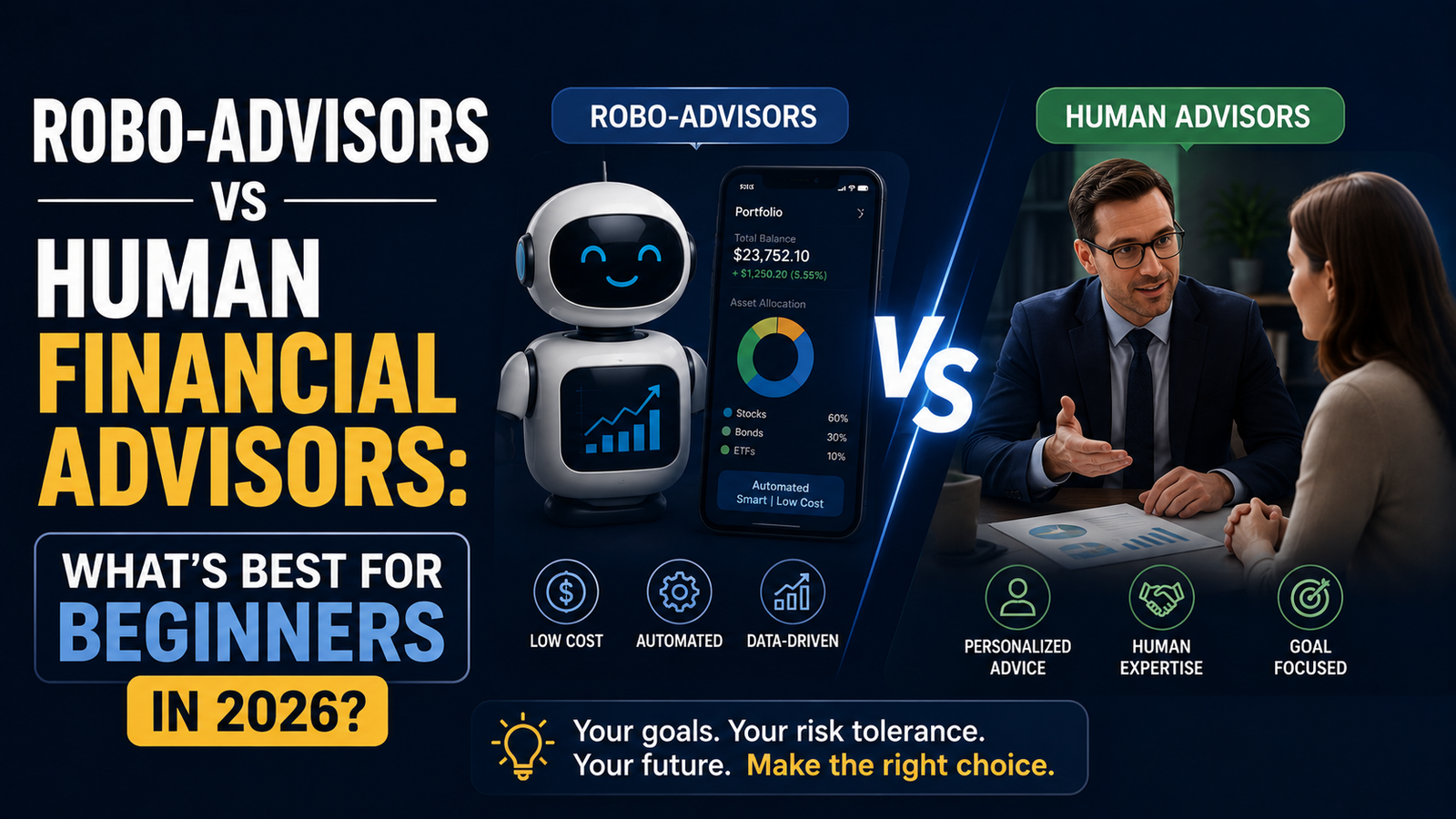
For decades, getting professional investment help in America meant one thing: sitting down with a human financial advisor, usually with a minimum account balance in the tens of thousands of dollars, and paying an annual fee that ate into returns year after year. That model still exists, but it’s no longer the only option — or even the default one for a growing number of beginner investors.
Robo-advisors, automated investment platforms that build and manage a portfolio using algorithms rather than a person, have gone from a niche fintech experiment to a mainstream part of the American investing landscape. In 2026, the question facing most new investors isn’t really “robot or human” anymore — it’s understanding what each actually offers, what they cost, and which combination makes the most sense for where someone is starting from.
This article breaks down exactly how robo-advisors and human financial advisors compare in 2026, what the real cost difference means over time, and how beginners specifically should think about the decision.
What a Robo-Advisor Actually Is
A robo-advisor is a digital investment platform that builds and manages a diversified portfolio automatically, based on answers to a questionnaire about goals, timeline, and risk tolerance. Once set up, the platform handles portfolio construction, automatic rebalancing, and in many cases, basic tax-loss harvesting, all without requiring the investor to actively manage individual holdings.
Morningstar has described robo-advisors as occupying a middle ground between a full-service wealth manager and a do-it-yourself trading platform — more hands-off than picking individual stocks, but still automated rather than personally guided by a human advisor sitting across the table.
The category has grown substantially. Robo-advisor assets under management crossed the $1 trillion mark by the end of 2022 and are projected to reach roughly $7 trillion by 2029, driven largely by younger, digitally native investors who are comfortable managing their finances through an app rather than an in-person relationship.
What a Human Financial Advisor Actually Offers
A human financial advisor provides personalized guidance that goes well beyond portfolio construction. Traditional advisors, including Certified Financial Planners (CFPs) and Registered Investment Advisors (RIAs), typically offer comprehensive planning that covers tax strategy, estate planning, insurance needs, Social Security timing, retirement income planning, and behavioral coaching during market volatility — services that fall well outside what an algorithm-driven platform is designed to handle.
Pricing for human advisors varies more than robo-advisor pricing. Most charge a percentage of assets under management (AUM), typically in the range of 0.80% to 1.25% annually, though flat annual retainers ($3,000 to $10,000 or more) and hourly rates ($200 to $500) are also common. According to industry research from Kitces, the vast majority of financial advisors — around 92% — incorporate an AUM-based fee into their pricing in some form.
Access can also be a barrier for beginners specifically. A significant share of financial advisors, roughly two-thirds according to recent industry data, require account minimums of $250,000 or more, reflecting the reality that the complexity and personalization human advisors provide often doesn’t make economic sense for smaller portfolios, at least from the advisor’s business model perspective.
The Cost Gap Is the Single Biggest Difference
If there’s one factor that separates robo-advisors from human advisors most dramatically, it’s cost — and the gap is significant enough to meaningfully affect long-term investment outcomes.
As of recent data, the median robo-advisor fee sits at around 0.25% of assets annually. Human financial advisors, by contrast, typically charge close to four times that amount, averaging around 1% of assets under management per year, with many charging even more.
That difference might sound small in percentage terms, but compounded over decades, it becomes substantial. Analysis comparing a robo-advisor fee of roughly 0.30% against a human advisor fee of 1.50% found that over a 20-year period, the fee gap alone could cost an investor with a $500,000 portfolio close to $470,000 in lost growth — money that stays invested and compounds under the lower-cost model instead of being paid out in advisory fees.
This doesn’t automatically mean robo-advisors are the better choice for everyone. But it does mean the fee difference deserves serious consideration, especially for beginner investors with smaller account balances where every basis point of fee has a larger proportional impact on long-term growth.
Where Robo-Advisors Genuinely Excel
For beginner investors specifically, robo-advisors offer several distinct advantages that make them a genuinely strong starting point.
Low or no account minimums. Unlike many human advisors who require $25,000, $100,000, or more to open an account, most robo-advisors allow investors to start with far smaller amounts, sometimes even $0, making them far more accessible for someone just beginning to invest.
Low, transparent fees. The straightforward, low percentage-based fee structure of most robo-advisors is easier to understand and compare across platforms than the varied fee structures common among human advisors.
Automatic, disciplined portfolio management. Robo-advisors handle rebalancing and, in many cases, tax-loss harvesting automatically, removing the emotional decision-making that often leads inexperienced investors to make costly mistakes, like panic-selling during a market downturn.
Market-matching performance for straightforward goals. For investors with simple, clear objectives — building a diversified portfolio and letting it grow over time — robo-advisors typically deliver returns comparable to a standard benchmark portfolio, without requiring the investor to have deep investing knowledge.
Accessibility for tech-comfortable beginners. For younger investors who are already comfortable managing much of their financial life through apps, a robo-advisor’s digital-first experience often feels more natural and less intimidating than scheduling an in-person meeting with an unfamiliar advisor.
Where Human Advisors Still Clearly Win
Despite the growth of automated platforms, there are specific situations where a human advisor’s value becomes difficult for any algorithm to replace.
Complex financial situations. Equity compensation, real estate holdings, multi-generational wealth planning, and complicated tax situations typically require judgment and coordination that goes well beyond what a robo-advisor’s algorithm is designed to handle.
Major life-stage decisions. Choices like when to claim Social Security, whether to do a Roth conversion, or how to structure retirement income withdrawals involve nuanced tradeoffs that benefit significantly from personalized, experienced human judgment, particularly for investors approaching or already in retirement.
Behavioral coaching during high-stress moments. One of the most consistently cited values human advisors provide isn’t investment selection — it’s helping clients stay disciplined and avoid emotionally driven mistakes during periods of market volatility, a form of guidance that’s harder to replicate through an app notification.
Comprehensive, coordinated planning. For investors whose financial lives involve multiple moving pieces — insurance, estate planning, tax strategy, and investments all needing to work together — human advisors are better positioned to coordinate across these areas holistically.
The Rise of the Hybrid Model
Perhaps the most significant shift in 2026 isn’t robo-advisors replacing human advisors, or vice versa — it’s the rapid growth of hybrid models that combine both. Major platforms including Vanguard, Schwab, Fidelity, and Betterment now offer blended services that pair algorithmic portfolio management with access to a human Certified Financial Planner, typically at a fee that sits between the pure-robo and pure-human pricing extremes, often in the 0.30% to 0.65% range depending on the provider and service tier.
This hybrid approach has emerged as the practical answer to a common realization: most investors don’t need the full cost of a traditional human advisor for basic portfolio management, but they also don’t want to be entirely without human guidance for the bigger, less frequent decisions that genuinely benefit from personalized judgment. For many beginner and intermediate investors, this middle ground increasingly represents the most cost-effective way to get both automated efficiency and human expertise when it actually matters.
AI Is Starting to Blur the Lines Further
2026 has also seen a new wave of AI-powered advisory tools that go beyond traditional robo-advisor questionnaires, offering more conversational, personalized interactions that feel closer to talking with a knowledgeable person than filling out a static form. Some major platforms have introduced AI advisory features that let users ask specific, contextual questions about their own portfolio and receive tailored responses, rather than generic, one-size-fits-all guidance.
This trend is worth watching closely, since it represents a meaningful evolution from earlier, more rigid robo-advisor models. That said, even the most advanced AI advisory tools in 2026 are generally viewed by industry analysts as strong for portfolio mechanics and general guidance, but still limited when it comes to the kind of deeply personalized, judgment-heavy planning that complex financial situations require.
How Beginners Should Actually Decide
For someone just starting their investing journey, the decision typically comes down to a few practical questions.
If your situation is straightforward — you want a diversified portfolio, low costs, and automated management without needing complex tax or estate planning — a robo-advisor alone is likely to fully meet your needs, and the lower fees will meaningfully benefit your long-term returns.
If you have a more complex financial picture — significant equity compensation, real estate, multiple income sources, or upcoming major life decisions like marriage, home buying, or approaching retirement — a hybrid model or human advisor is likely to provide value that justifies the higher cost.
If cost is the primary constraint — which is common for genuine beginners with smaller account balances — starting with a pure robo-advisor and reassessing as your portfolio and financial complexity grow is a reasonable, low-risk approach.
If you know you struggle with emotional investing decisions — panic-selling during downturns or chasing trends — the behavioral coaching a human advisor or hybrid model provides may be worth the additional cost, even for a beginner, since avoiding a single major emotional mistake can offset years of fee savings.
The Bottom Line
The old framing of robo-advisors versus human financial advisors as a binary choice no longer reflects how the industry actually works in 2026. For beginners specifically, robo-advisors offer a genuinely strong, low-cost entry point into disciplined, diversified investing, particularly for straightforward financial situations without significant complexity. Human advisors remain difficult to replace for complex planning, major life decisions, and behavioral coaching during turbulent markets.
For most new investors, the most practical starting point is a low-cost robo-advisor or hybrid platform, with the option to add human advisory access later as financial complexity grows. The right choice ultimately depends less on which option sounds more modern or more traditional, and more on the honest complexity of your own financial situation — and how much that complexity is likely to grow in the years ahead.