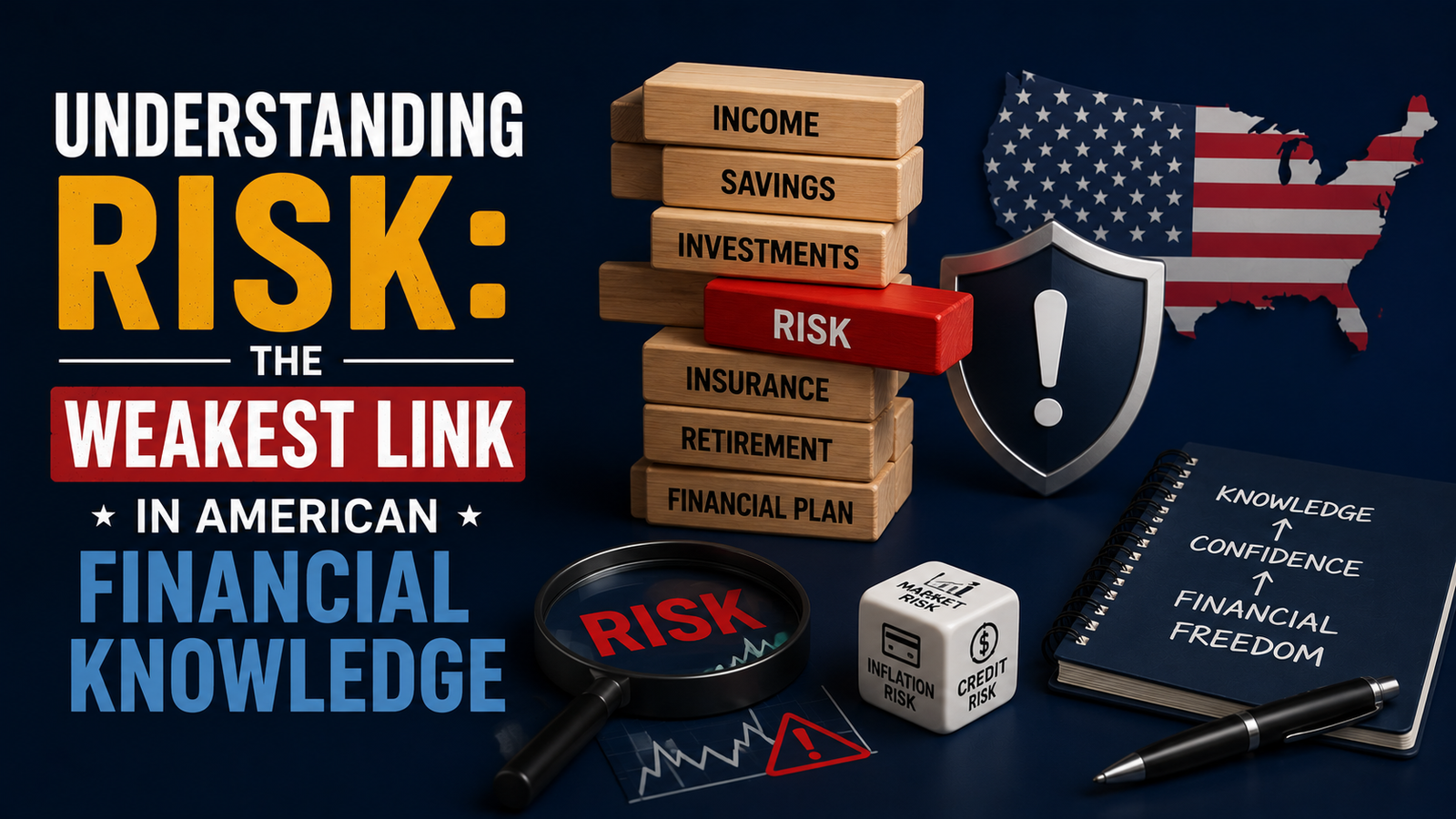
Ask most Americans whether they should save for retirement, and they’ll say yes. Ask them whether they should have an emergency fund, and they’ll agree with that too. But ask them to actually explain what “risk” means in a financial context — how it should shape a mortgage choice, an investment portfolio, or an insurance policy — and the data shows something surprising: this is where American financial knowledge consistently falls apart, more than any other area, across every single generation.
Risk comprehension isn’t just one weak spot among many in the American financial literacy landscape. According to the country’s longest-running financial literacy tracker, it’s the single weakest category measured, year after year, regardless of age, income, or education level. This article explores why understanding risk has become the country’s biggest financial blind spot, what it’s costing Americans, and what can actually be done about it.
The Data: Risk Is America’s Financial Achilles’ Heel
The 2026 Personal Finance Index, produced by the TIAA Institute and the Global Financial Literacy Excellence Center (GFLEC), has tracked financial literacy among U.S. adults for a full decade using 28 questions spanning eight core areas: earning, consuming, saving, investing, borrowing, insuring, comprehending risk, and knowing where to find reliable financial information.
Across all eight categories, risk comprehension consistently ranks dead last. In the 2026 survey, Americans correctly answered just 36% of risk-related questions, meaningfully lower than every other category measured. For comparison, Americans performed considerably better in areas like saving and debt management, where scores have historically hovered in the mid-50s to high-50s percentage range.
What makes this finding particularly significant is what researchers describe as its universality. Nearly every other area of financial knowledge in the index shows some variation by age — older adults tend to score somewhat better than younger ones in categories like borrowing or saving, reflecting accumulated life experience. Risk comprehension breaks that pattern entirely. It’s the one functional area where performance stays consistently weak across every single generation, showing little to no improvement even among older, more financially experienced adults.
As one wealth management advisor quoted in coverage of the findings put it, understanding risk touches virtually every major financial decision a person makes — from insurance choices to evaluating financial products — which makes this particular blind spot far more consequential than a narrow gap in a single niche topic.
Why Risk Is So Much Harder to Understand Than Other Financial Concepts
Several factors help explain why risk comprehension lags so far behind other areas of financial knowledge.
Risk Is Abstract, While Other Financial Concepts Are Concrete
Concepts like budgeting or debt repayment have a clear, tangible feedback loop — you can see your bank balance, watch a credit card balance shrink, or track progress toward a savings goal. Risk, by contrast, is fundamentally about probability and uncertainty: the chance that a market will decline, the likelihood of needing long-term care, or the probability that an insurance claim will actually be needed. These are inherently harder concepts for the human brain to internalize, because there’s no simple visual or immediate feedback that reinforces understanding the way a shrinking debt balance does.
Understanding Risk Intellectually Is Different From Feeling It Emotionally
Financial planning professionals who work directly with clients have observed a specific, recurring pattern: people often understand the concept of investment volatility in the abstract, but that intellectual understanding often collapses the moment their actual portfolio value drops. Knowing that markets fluctuate is very different from calmly tolerating a real account balance falling by 20% during a downturn. This emotional-intellectual gap means that even people who could correctly answer a quiz question about risk may still make poor real-world decisions when actual risk materializes, like panic-selling investments during a market dip.
Risk Comprehension Requires Understanding Multiple Interacting Variables
Unlike a straightforward concept such as “pay more than the minimum on your credit card,” genuinely understanding financial risk requires grasping how multiple factors interact: time horizon, diversification, probability, and personal circumstances all shape what an appropriate level of risk actually looks like for a given person. This complexity makes risk comprehension a fundamentally harder skill to teach and retain compared to more procedural financial knowledge.
Where the Risk Gap Shows Up Most Dangerously
Poor risk comprehension isn’t just a quiz-score problem — it directly undermines some of the most consequential financial decisions Americans make.
Retirement Planning
Understanding risk is foundational to sound retirement planning, from choosing an appropriate investment mix at different life stages to understanding the real probability of needing long-term care later in life. The same 2026 research that identified risk as the weakest literacy category also found that retirement fluency specifically is alarmingly low — on average, adults correctly answered only about two of six retirement-related questions, and barely a quarter of respondents correctly understood the actual likelihood that a 65-year-old will eventually need long-term care. Underestimating that risk can lead directly to underfunded retirement plans that don’t account for major late-life expenses.
Insurance Decisions
Insuring ranks as one of the weakest categories in the broader financial literacy index, closely tied to risk comprehension, since insurance is fundamentally a tool for managing financial risk. Poor understanding in this area can lead to being underinsured against real risks, overpaying for coverage that isn’t actually needed, or misunderstanding what a policy actually covers, a gap that becomes especially costly at the exact moment a claim needs to be filed.
Investment Portfolio Decisions
Investing performance in the broader literacy index also tends to run below average, and financial professionals note that many people conflate “willingness” to take investment risk with actual “understanding” of what that risk means in practice. Someone may say they’re comfortable with a volatile, growth-oriented portfolio without truly grasping what that volatility will look and feel like when a downturn actually happens, leading to reactive decisions, like selling at a loss during a downturn, that undermine long-term returns.
Debt and Borrowing Choices
Risk comprehension also plays an underappreciated role in borrowing decisions, from understanding the real risk of an adjustable-rate mortgage compared to a fixed-rate loan, to grasping the compounding risk of carrying high-interest debt over time. A weak grasp of risk can make these choices feel abstract or distant, until the consequences become concrete.
The Real Financial Cost of Poor Risk Understanding
Weak financial literacy in general carries a measurable price tag. Prior research has estimated the cost of financial illiteracy to Americans in the hundreds of billions of dollars annually, driven by costly financial mistakes, missed opportunities, and inefficient financial decisions. Because risk comprehension underlies so many of the most consequential financial choices people make, it’s reasonable to view it as one of the largest contributors to that broader cost.
The burden isn’t just financial — it’s also a drain on time and mental energy. Research has found that individuals with very low overall financial literacy are far more likely to spend significant chunks of their week dealing with financial stress and problems, time that could otherwise go toward work, family, or simply peace of mind.
Who Struggles Most With Risk Comprehension
While risk comprehension is weak across the board, a few patterns stand out in the 2026 data.
The gender gap is especially pronounced in this category. Women score significantly lower than men across nearly every functional area of the broader financial literacy index, but the gap is particularly wide in investing, insuring, and comprehending risk — the exact areas where overall performance is already weakest. This isn’t explained simply by differences in demographics like income or education; researchers have found the gap persists even after accounting for those factors.
Gen Z faces a compounding disadvantage. Not only does Gen Z score lowest overall on financial literacy, but insuring is specifically identified as Gen Z’s single weakest area relative to other generations — meaning younger Americans are entering adulthood with the least developed understanding of risk-related concepts precisely when they’re starting to make foundational financial decisions.
Age doesn’t reliably fix the problem. Unlike most other financial knowledge categories, where older adults tend to outperform younger ones, risk comprehension stays persistently weak even among older Americans, including those actively navigating retirement decisions where risk understanding matters most.
How to Actually Build Risk Literacy
Improving risk comprehension requires a different approach than memorizing financial facts, since the challenge lies in understanding probability and uncertainty rather than simple procedural knowledge. A few practical approaches can help.
Learn to separate “risk tolerance” from “risk capacity.” Risk tolerance is how comfortable someone feels with uncertainty emotionally; risk capacity is how much financial risk someone can actually afford to take given their timeline and circumstances. Understanding that these are two different things — and that decisions should be based on both — is one of the most practical risk literacy skills someone can develop.
Use real historical examples, not just abstract percentages. Understanding that a diversified stock portfolio has historically declined by 20% or more during multiple periods over the past several decades, and still recovered over time, tends to build more durable, realistic risk understanding than simply being told “stocks are risky in the short term.”
Ask “what happens if I’m wrong?” before major decisions. A practical way to engage with risk is to explicitly ask what the actual consequences would be if an assumption turns out to be incorrect — for example, what happens financially if a variable-rate loan’s interest rate rises significantly, or if a portfolio experiences a downturn shortly before a planned withdrawal.
Talk to a professional before, not after, taking on major risk. Financial advisors specifically note that clients often don’t realize the extent of their own risk knowledge gaps until those gaps are actively surfaced in a planning conversation. Proactively discussing risk tolerance and capacity with a professional, rather than waiting until a problem arises, can catch dangerous misunderstandings before they become costly mistakes.
Prioritize risk education specifically, not just general financial literacy. Because risk comprehension is uniquely resistant to improving with age or general financial experience, closing this particular gap may require more deliberate, targeted educational efforts rather than assuming it will improve as a byproduct of broader financial literacy education.
The Bottom Line
Of all the financial knowledge gaps facing Americans today, risk comprehension stands out as both the most severe and the most universal — a weakness that doesn’t discriminate by age, doesn’t reliably improve with life experience, and directly undermines decisions that shape decades of financial security, from retirement planning to insurance to investing.
The persistence of this gap, even among older adults who have accumulated significant financial experience elsewhere, suggests that risk literacy isn’t something people naturally pick up through everyday financial life. It has to be deliberately taught and reinforced. For a country where financial literacy overall has just hit its lowest recorded level, closing the risk comprehension gap specifically may be one of the highest-leverage places to focus — because so much of what determines long-term financial security ultimately comes down to how well someone understands, and prepares for, what they don’t yet know will happen.