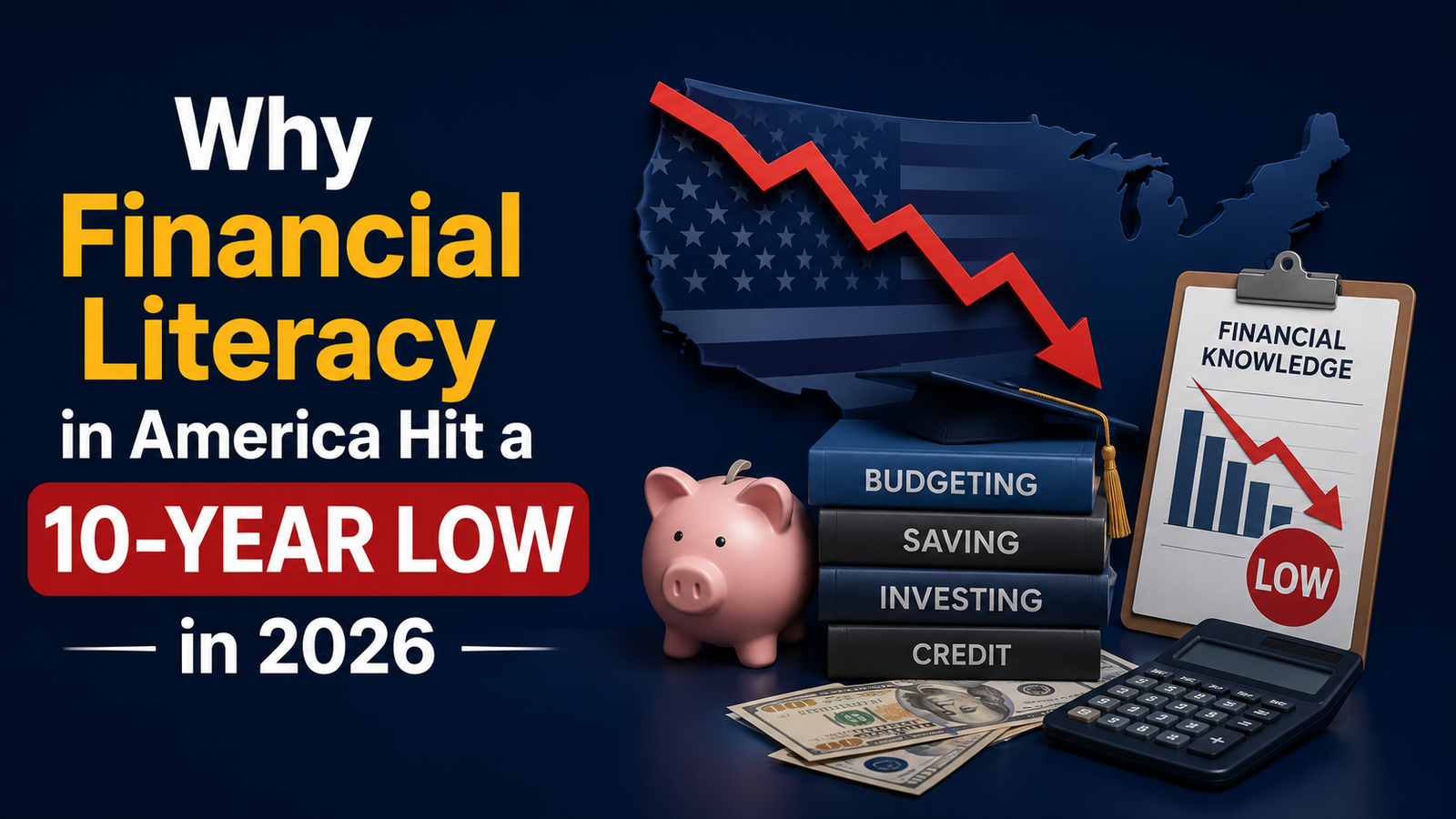
For a decade, one survey has quietly tracked something most Americans never think to measure: how well people actually understand money. The Personal Finance Index, published annually by the TIAA Institute and the Global Financial Literacy Excellence Center (GFLEC), has become one of the most respected benchmarks of financial knowledge in the country. Its 2026 edition, marking ten years of data collection, delivered a result nobody wanted to see.
Financial literacy among U.S. adults has fallen to its lowest point since the survey began. Americans answered less than half of the index’s questions correctly, on average, and the decline wasn’t isolated to one group or one topic. It touched multiple generations, multiple income levels, and multiple areas of everyday financial life.
This article breaks down what the 2026 findings actually show, why the decline is happening now, who is being affected the most, and what it means for the future of financial education in the United States.
The Numbers Behind the Decline
The 2026 P-Fin Index surveyed thousands of U.S. adults across five generations, from Gen Z to the Silent Generation, using 28 questions covering eight core areas of personal finance: earning, consuming, saving, investing, borrowing and managing debt, insuring, comprehending risk, and knowing where to find reliable financial information.
The headline result was stark. On average, Americans correctly answered only 47% of the questions — a statistically significant drop from the year before, and the lowest score recorded in the index’s ten-year history. Just as concerning, the share of adults classified as having very low financial literacy has been climbing steadily, rising from one in five adults in 2017 to one in four in 2026.
What makes this decline notable is its breadth. Financial literacy didn’t drop in just one or two areas — it fell significantly across five of the eight functional categories measured: consuming, borrowing, earning, insuring, and comprehending risk. A decline this widespread suggests a broader, systemic issue rather than a temporary dip tied to one specific event or news cycle.
Comprehending Risk: The Weakest Link for Every Generation
If there’s one area where the data paints the clearest warning sign, it’s risk comprehension. Across every single generation surveyed — from Gen Z to baby boomers — understanding financial risk was consistently the weakest of the eight knowledge areas. Only about a third of risk-related questions were answered correctly nationwide.
This matters more than it might seem at first glance. Understanding risk isn’t just an academic exercise; it underlies nearly every major financial decision a person makes. It affects how someone chooses between a fixed-rate and adjustable-rate mortgage, how they build an investment portfolio, how much insurance coverage they actually need, and how they interpret the odds of unexpected expenses like a medical emergency or a job loss.
The fact that risk comprehension doesn’t meaningfully improve with age is particularly telling. Financial literacy in most other areas tends to rise somewhat as people accumulate life experience — but risk understanding stays persistently low across the board, suggesting it isn’t being taught effectively at any stage of life, whether in school, in the workplace, or through informal financial exposure.
Retirement Knowledge Is in Even Worse Shape
Beyond the core 28 questions, the 2026 index included six additional questions specifically testing retirement fluency, and the results were arguably even more concerning than the general literacy findings.
On average, adults correctly answered only about two out of six retirement-related questions. Just over a quarter of respondents correctly understood how much Medicare actually covers in retirement, and a similar share understood the real likelihood that a 65-year-old will eventually need long-term care. These aren’t obscure technicalities — they’re fundamental pieces of information that directly affect how much someone needs to save, when they can afford to retire, and whether they’ll be financially prepared for healthcare costs later in life.
The consequences of this knowledge gap show up in real behavior. Workers who correctly answered four or more of the six retirement fluency questions were found to be nearly twice as likely to save for retirement consistently, and more than twice as likely to have actually calculated how much they need to save for retirement, compared to workers who answered one question or none correctly. In other words, retirement knowledge isn’t just a matter of passing a quiz — it’s directly tied to whether people take the concrete steps needed to be financially secure later in life.
Who Is Being Left Behind
The 2026 findings make clear that financial literacy in America isn’t declining evenly. Several persistent and, in some cases, widening gaps stand out.
The Generational Divide
Gen Z stands out as having the lowest financial literacy scores of any generation surveyed, correctly answering only about 38% of questions on average. This is a striking finding given that Gen Z has grown up with more access to financial apps, budgeting tools, and online information than any previous generation. Access to technology, it turns out, hasn’t automatically translated into financial understanding.
The Gender Gap
A persistent gender gap continues to show up across nearly every functional area of the index, with women scoring roughly six percentage points lower than men on average. This gap has remained remarkably stable over the years the survey has been conducted, suggesting it reflects deeper structural and educational patterns rather than a temporary anomaly.
The Education Gap
Formal education plays an outsized role in financial literacy outcomes. Adults with a bachelor’s degree or higher correctly answered roughly twice as many questions, on average, as those without a high school diploma. This gap reinforces a broader concern: financial literacy in America is increasingly tied to educational and economic privilege, rather than being a baseline skill everyone acquires regardless of background.
The Financial Education Gap
Perhaps the most actionable finding in the entire report is this: adults who report having received formal financial education score significantly higher than those who haven’t — roughly 13 percentage points higher. This single data point underscores just how much of a difference structured financial education can make, and by extension, how much is being lost by not providing it more broadly and more rigorously.
The Real-World Cost of Low Financial Literacy
It’s tempting to treat financial literacy as an abstract, academic concern — something that shows up in survey results but doesn’t affect daily life in a tangible way. The 2026 index suggests otherwise.
One of the report’s most striking findings is that workers with very low financial literacy spend nearly 11 hours per week dealing with money-related issues and stress while at work — the equivalent of losing more than an entire workday to financial distraction and problem-solving. That’s not just a personal cost; it’s a productivity cost that ripples out to employers and, at scale, to the broader economy.
Low financial literacy has also been linked in prior years of this same research to higher levels of financial anxiety, lower emergency savings, higher use of high-cost debt like payday loans, and reduced retirement readiness. The 2026 data reinforces that these patterns aren’t improving — they’re getting worse.
Where AI Fits Into the Picture
One of the newer angles explored in the 2026 index is the growing role of artificial intelligence in personal finance. The findings show that while AI use is rising, it’s still far from mainstream when it comes to actual financial management. About one in five U.S. adults have used an AI tool such as ChatGPT or Gemini to get information about a personal finance topic, but only a small fraction use AI regularly to help manage their finances day to day.
Unsurprisingly, AI adoption follows the same generational pattern seen elsewhere in the survey — usage is highest among Gen Z and lowest among baby boomers. More importantly, the research found that AI use in personal finance is strongly correlated with financial literacy levels, meaning the people already most financially literate are also the ones most likely to use AI tools effectively, while those who could benefit the most from accessible, on-demand financial guidance may be the least likely to seek it out through these newer channels.
Why Financial Literacy Keeps Declining
A few structural factors help explain why financial literacy in America continues to slide rather than improve, even as financial information has never been more accessible online.
Personal finance education in schools remains inconsistent. While a growing number of states have introduced personal finance requirements in recent years, the quality, rigor, and consistency of that instruction varies enormously. Many students still receive only a handful of hours of personal finance instruction across their entire high school career, often folded into broader economics or math courses rather than taught as a dedicated subject.
The financial landscape has gotten more complex, not less. Between the rise of “buy now, pay later” services, cryptocurrency, more complex investment products, and AI-powered financial tools, the average American now has to navigate a far more complicated financial environment than previous generations did, often without a proportional increase in financial education to match.
Information overload doesn’t equal understanding. There’s more financial content available online than ever before — from social media “finfluencers” to countless budgeting apps and YouTube explainers — but volume of information doesn’t necessarily translate into accurate understanding. In some cases, it creates confusion or spreads oversimplified or outright incorrect financial advice.
What Needs to Change
The researchers behind the P-Fin Index frame the 2026 results as a call to action rather than just a data point to observe. A few clear priorities emerge from the findings.
Financial education needs to be more consistent and rigorous across states, rather than treated as an optional or lightly regulated subject. Retirement and risk literacy, specifically, need targeted attention, since both areas are consistently the weakest across all demographics and directly affect long-term financial security. Employers have an incentive to get involved as well, given the direct link between low financial literacy and lost workplace productivity. And any efforts to close persistent gender and education-based gaps will need to go beyond general awareness campaigns and focus on structural access to quality financial education, particularly for groups that have historically been underserved.
The Bottom Line
The 2026 P-Fin Index doesn’t just report a number — it documents a decade-long trend that has now reached a breaking point. Financial literacy among U.S. adults is at its lowest level since tracking began, the decline is broad-based rather than isolated, and the consequences are measurable in real financial stress, lost productivity, and reduced retirement readiness.
The encouraging part of the data is that the solution is already visible within it. Adults who receive structured financial education consistently outperform those who don’t, by a meaningful margin. The gap isn’t a mystery — it’s a matter of access, consistency, and priority. Closing it will require treating financial literacy not as a nice-to-have life skill, but as a core piece of education that every American, regardless of age, income, or background, has a real opportunity to learn.